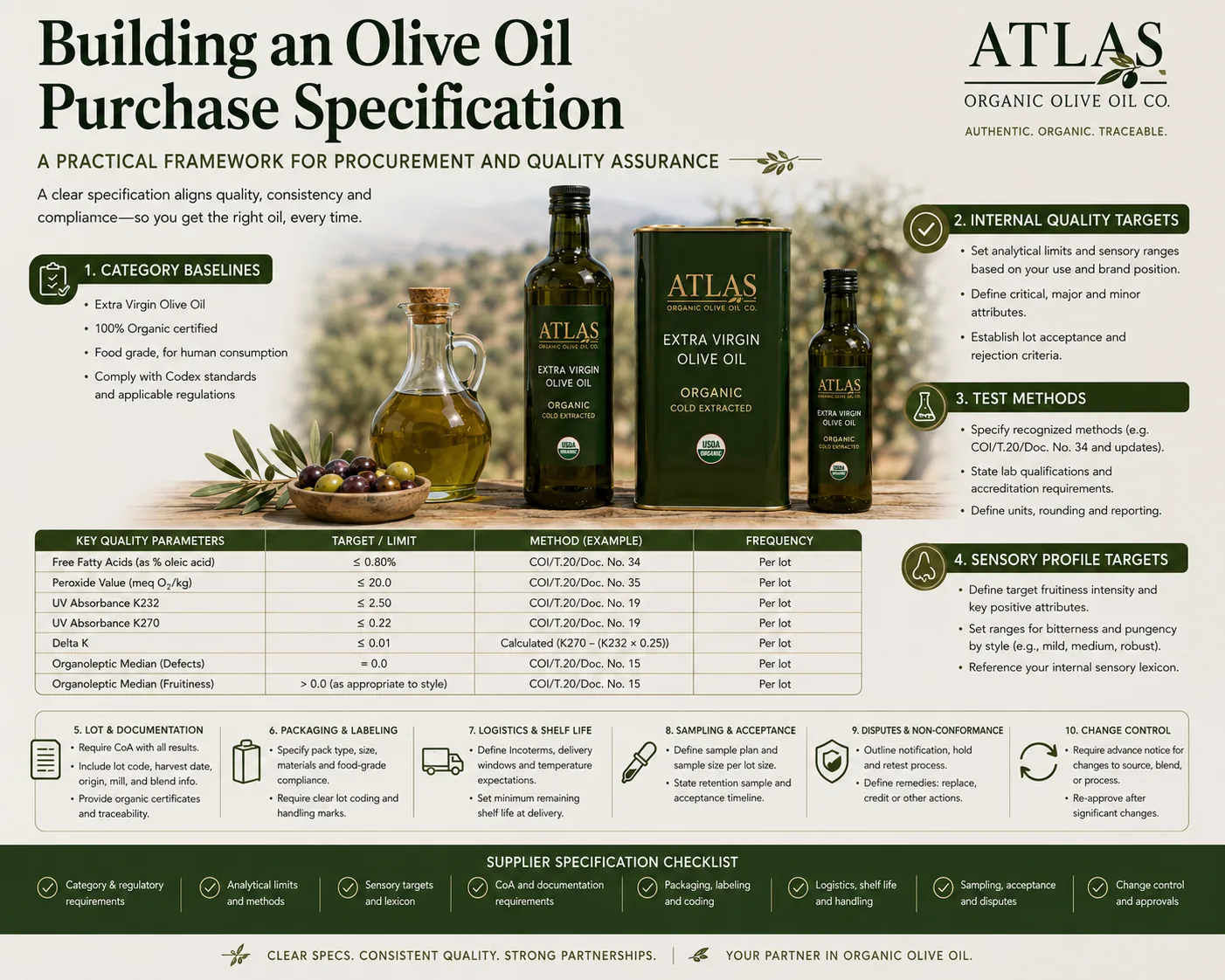
A purchase specification converts brand intent into measurable acceptance criteria. It should be specific enough to protect quality while leaving room for natural agricultural variation.
Procurement translates desired quality into a repeatable supply system. Specification, supplier qualification, forecast, documentation, logistics, receiving controls, change management and dispute rules should be defined before scale-up rather than negotiated after a shipment is already in question.
The practical objective is not to write the longest possible document. It is to make the important commercial decisions clear enough that the buyer and supplier know what is required, how it will be measured and what happens when a lot falls outside the agreed range.
1. Start with the decision framework
Before writing limits, define the commercial job the oil must perform. The brief should state the finished product or service application, destination market, annual and trial volumes, expected pack format, sensory role, process exposure, storage conditions, organic requirements and the business reason behind any tighter internal quality targets.
- Define the legal or category baseline separately from tighter internal targets.
- Include sensory style, filtration, organic status, lot documents, packaging, coding, age expectations and shipping conditions.
- State sampling, test methods, dispute procedures and which result governs if supplier and buyer laboratories disagree.
- Identify which attributes are mandatory release criteria and which are merely preferred or typical.
A useful specification distinguishes requirements that determine acceptance from background information. If a harvest date, cultivar, origin or typical analytical value is informative but not contractually required, label it accordingly.
This prevents normal agricultural variation from being mistaken for nonconformance while still protecting the characteristics that matter to the finished product.
2. Separate category requirements from internal targets
The first technical layer is the applicable olive-oil category and destination-market framework. Those requirements should be identified independently from the buyer's own tighter commercial targets.
Internal limits can be useful for consistency, quality margin or brand positioning, but they should have a defined purpose. A lower numerical target should not be included merely because it appears more premium.
The specification should clearly identify whether a value is a regulatory or category maximum, contractual rejection limit, internal target or typical supplier value.
This distinction becomes especially important when procurement, quality and suppliers use the same specification for release decisions.
3. Define product identity precisely
Product identity should be stated before analytical numbers. The specification can include the required olive-oil category, organic status, filtration status and any agreed harvest, origin or cultivar requirements.
If origin or harvest style is commercially important, the document should explain whether it is mandatory for every lot or simply part of the approved sourcing profile.
Organic status should be supported separately through the applicable certification and traceability records. Organic certification does not by itself establish extra-virgin category, and category conformity does not establish organic status.
4. Write analytical requirements with methods
A numerical specification is stronger when the parameter, reporting basis, analytical method and lot requirement are clear.
Free acidity, peroxide value, UV absorbance and any other applicable quality or authenticity parameters should be listed according to the governing category, destination market and buyer risk program.
The document should avoid isolated numbers that can be interpreted differently by supplier and buyer laboratories. Where method references matter, include them.
Current-lot certificate-of-analysis requirements should also be clear: which parameters are required for every lot, which are periodic and which may be supplied through another approved verification program.
5. Turn sensory intent into a usable range
Sensory requirements should protect the brand or formulation without pretending that an agricultural product will taste exactly identical every harvest.
Where applicable, start with the organoleptic requirements of the commercial category. Then add buyer-specific direction for fruitiness, bitterness, pungency and any attributes that should be avoided.
A sensory range is often more workable than an exact fixed profile. For example, the buyer can define mild, medium or robust intensity together with approved reference samples or descriptive boundaries.
Retained samples and documented panel notes can make supplier and crop-year comparisons more repeatable.
6. Practical workflow
Build the specification from intended use to measurable controls. First define the product role. Second, qualify representative samples. Third, document the required analytical, sensory, packaging and logistical criteria. Finally, test the specification against a real commercial shipment before treating it as final.
- Write a one-page sourcing brief. Include category, organic status, application, sensory target, pack, annual volume, destination and timing.
- Approve representative samples. Taste for category condition and commercial style, then evaluate in the actual use.
- Define analytical criteria. List required parameters, methods, units, lot frequency and internal targets.
- Define documentation. State COA, organic, traceability, import, origin and other required records.
- Define pack and logistics. Specify container, closure, seals, lot coding, palletization, Incoterm and handling.
- Define sampling and receiving. State how samples are identified and which checks occur before lot release.
- Define dispute handling. Establish the procedure for conflicting analytical or sensory results.
- Define change control. Identify supplier changes that require notification, review or buyer reapproval.
7. Define what the certificate of analysis must show
A COA requirement should describe more than a list of numbers. It should specify enough information to connect the analytical results to the commercial lot.
Useful fields can include supplier lot number, sample identity, test date, laboratory, analytical methods and all parameters required for release.
Historical or typical values can support supplier qualification, but they should not automatically substitute for current-lot results when the purchase specification requires lot-specific testing.
The specification should also state whether electronic certificates are acceptable and when documents must be available relative to shipment or receipt.
8. Include sampling in the specification
The laboratory analyzes the sample submitted, so sample identity and collection matter to the commercial decision.
The specification can state whether routine supplier samples are sufficient, whether the buyer will sample on receipt or whether higher-risk or disputed lots require a defined sampling procedure.
For bulk tanks, tankers or flexitanks, the sampling basis may deserve more detail than for individually sealed retail units.
Retained samples can support later investigation if buyer and supplier results disagree or if product condition changes during downstream storage.
9. Define documentation beyond the COA
Quality documentation is only one part of the supply record. Organic programs may also require current certification information, transaction records and traceability evidence appropriate to the commercial route.
Depending on the destination and product, the buyer may also require origin, import, food-safety, packaging or label-support documents.
The purchase specification should identify which records must accompany every lot, which are maintained at supplier-approval level and which are supplied only when specifically requested.
Clear document ownership prevents shipment delays caused by discovering missing paperwork only after goods are already in transit.
10. Put packaging inside the ingredient specification
Packaging affects storage, handling, light exposure, oxygen exposure, lot identification and the buyer's ability to consume the oil efficiently.
The specification should therefore define the approved food-contact format, net quantity, closure or valve, seal requirements and any liner or material expectations relevant to the program.
For retail or foodservice packs, case and pallet configuration may also matter. For bulk programs, connection type, unloading compatibility and container identification can be important receiving requirements.
Packaging changes should not automatically be treated as commercially neutral if they affect protection, handling or line compatibility.
11. Define age and shelf-life expectations carefully
A purchase specification can state acceptable production, packing, harvest or remaining-shelf-life expectations where they are commercially important.
These requirements should reflect real inventory turnover and downstream use rather than arbitrary dates copied from another program.
Incoming-oil age should also be distinguished from finished-product shelf life. One supplier specification cannot guarantee the shelf life of a formulated food.
Finished-product shelf life still needs validation using the actual formula, process, package, distribution and storage conditions.
12. Include transport and delivery conditions
Logistics can affect both product condition and commercial usability. The specification should identify the agreed Incoterm, delivery location, shipment documentation, pack configuration and any relevant handling expectations.
Buyers may also define delivery windows, advance-document requirements and receiving constraints so the shipment reaches a prepared site.
For bulk deliveries, tanker, flexitank, IBC or drum requirements should be coordinated with the receiving facility's equipment and storage capacity.
The transport requirement should protect the lot rather than assuming a compliant oil at shipment will remain unchanged regardless of downstream handling.
13. Quality controls that belong in the conversation
Extra virgin olive oil is defined through more than free acidity. Buyers should use the current applicable category standard, appropriate laboratory methods and, where required, organoleptic assessment.
- Separate legal or category minimums from internal commercial targets.
- Qualify the handling chain, not only the seller.
- Build harvest transitions and natural variation into the contract.
- Tie analytical results to the actual commercial lot.
- Define packaging, transport and storage requirements alongside ingredient quality.
- Maintain clear acceptance, hold, rejection and dispute procedures.
The specification should be strict where the product genuinely needs control and flexible where agricultural variability does not affect commercial performance. Over-specification can restrict supply without necessarily improving the finished product.
14. Build harvest transitions into the contract
Olive oil changes naturally from crop year to crop year. A good specification should therefore define the acceptable range and the process for approving a new harvest.
Buyers may require new-crop samples, updated analytical documents or sensory approval before the first shipment from a new harvest is released.
If the supplier uses blending to maintain a consistent profile, the agreed category, organic, origin and traceability requirements should remain intact.
The goal is controlled variation rather than the unrealistic expectation that every agricultural lot will reproduce one original sample exactly.
15. Define how disputes will be resolved
Supplier and buyer laboratories may occasionally produce materially different results. The specification should state how that situation is handled before it occurs.
The procedure can require review of lot identity, sampling, methods, test dates and storage history before either result is automatically accepted or rejected.
Depending on the commercial agreement, retained samples, repeat analysis or an agreed independent laboratory may support final disposition.
Sensory disputes can likewise benefit from an agreed panel, reference sample or defined escalation process rather than informal disagreement.
16. State which changes require buyer approval
A specification remains useful only if material changes are communicated. Supplier change control should identify which changes require notification and which require formal buyer reapproval.
Relevant changes can include origin, harvest, cultivar composition, processing, filtration, laboratory, analytical method, organic certification, packaging, closure, liner, pack size or shipping format.
The required level of review should match the commercial impact. Not every minor administrative change needs full requalification, but changes that can affect product identity, quality, certification or line compatibility should not pass unnoticed.
17. Common failure modes
Most specification failures come from ambiguity, missing methods or unrealistic requirements rather than from a shortage of numerical limits.
- Writing impossible fixed sensory descriptors for every harvest.
- Specifying analytical numbers without test methods or units.
- Treating typical values as guaranteed contractual limits.
- Leaving packaging and transport outside the ingredient specification.
- Accepting COAs that cannot be linked clearly to the shipped lot.
- Failing to define what happens when buyer and supplier laboratories disagree.
- Omitting organic, origin or traceability documentation requirements.
- Allowing material supplier changes without notification or reapproval.
Corrective-action triggers should be based on objective evidence: out-of-specification results, sensory defects, broken traceability, missing certification records, damaged packaging, transport deviations or unapproved changes.
The specification should also identify who has authority to place a lot on hold and what evidence is required for final acceptance, rework, return or rejection.
18. What to put in the purchase specification
A strong specification combines product identity, analytical criteria, sensory requirements, documentation, packaging, logistics and change control in one commercially usable framework.
19. Questions to ask a potential olive-oil supplier
Supplier qualification should test whether the supplier can consistently operate against the specification, not merely produce one attractive sample.
- Can every commercial lot be supplied with the required certificate of analysis?
- Which analytical methods and laboratories are used?
- How is the tested sample linked to the commercial shipment?
- How is organic status and lot traceability documented?
- How does the supplier manage normal harvest-to-harvest sensory variation?
- Are retained samples maintained for shipped lots?
- What procedure is used when buyer and supplier results disagree?
- How are material changes to origin, processing, packaging or certification communicated?
The objective is a repeatable sourcing relationship in which both parties understand what constitutes an acceptable lot and how exceptions are handled.
20. Reference framework
For olive-oil category definitions, analytical methods and organoleptic assessment, use the current International Olive Council trade standard and methods together with applicable destination-market requirements.
Organic status should be supported by the applicable certification and traceability framework. Packaging, transportation and storage requirements should reflect the buyer's actual operating conditions and quality system.
Finished-product shelf life should be validated using the actual formula, manufacturing process, package, distribution route and storage conditions rather than inferred from one incoming-oil specification.
Next step
Turn this guide into a working purchase specification by listing your required olive-oil category, application, annual volume, destination, sensory range, analytical parameters, organic documentation, pack format, delivery conditions and dispute procedure.
Atlas can then compare suitable organic extra virgin olive-oil programs on the same commercial basis and help align lot-specific quality, certification, packaging, traceability and logistics with your procurement requirements.