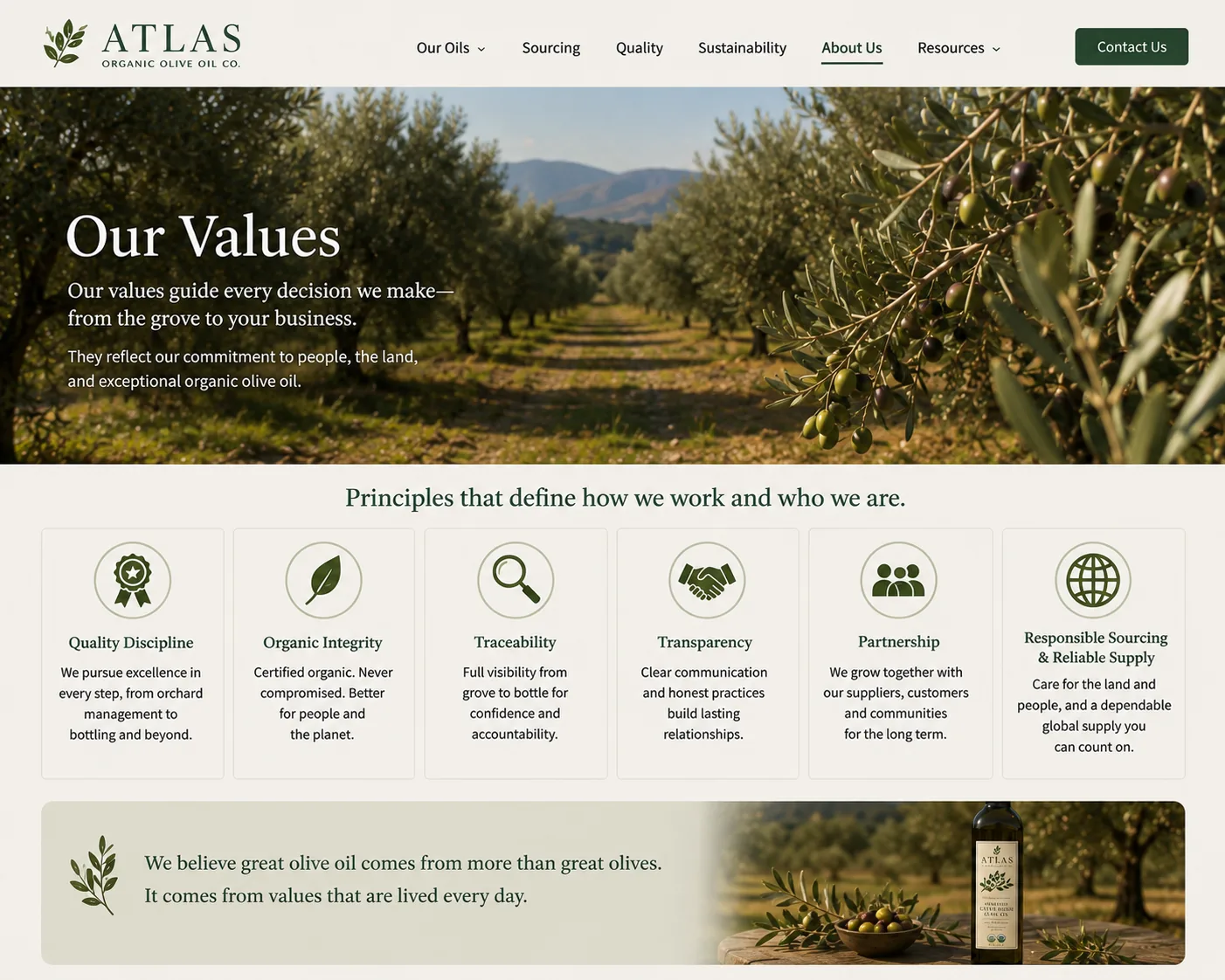
Seven standards we bring to every program.
Olive oil is agricultural, seasonal and sensory. Good sourcing respects that complexity instead of flattening it into one marketing claim.
Our role is to translate commercial expectations into practical sourcing criteria. That means understanding not only the finished oil, but also the documentation, handling, packaging, logistics and supplier relationships required to support it consistently over time.
Quality discipline
Define the intended category, analytical requirements, sensory condition, harvest style, filtration and handling expectations before purchase. Quality should be evaluated as a complete profile rather than reduced to a single laboratory number.
Organic integrity
Use relevant certification, transaction records and chain-of-custody documentation to support organic identity throughout sourcing, storage, packing and distribution. Organic status should remain connected to the actual commercial lot being supplied.
Traceability
Keep lot identity visible from source through milling, storage, packing, shipment and customer receipt. Strong traceability helps buyers understand what they purchased and supports quality review, documentation control and responsible lot management.
Transparency
Distinguish target specifications, typical values, reference characteristics and current-lot results clearly. We believe commercial buyers should know which information is descriptive, which is expected and which has been verified for the lot being offered.
Partnership
Build direct feedback loops among farms, mills, storage facilities, packers, logistics teams and buyers. Better communication allows specifications, forecasts, quality observations and operational requirements to move quickly through the supply chain.
Responsible sourcing
Turn sustainability ambitions into documented criteria that can be reviewed and improved. Depending on the program, this can include organic integrity, soil stewardship, resource awareness, packaging choices, traceability, waste reduction and supplier improvement initiatives.
Commercial reliability
Plan volumes, harvest transitions, packaging capacity, documentation, inventory and logistics as one connected system. Reliable supply requires more than locating a good oil; it also requires coordinating the commercial details that allow the same standard to be delivered repeatedly.
Would a technical buyer understand exactly what we mean?
We prefer precise commercial language over broad descriptions. The goal is not to remove the character of olive oil, but to make product claims useful to buyers, quality teams, importers, distributors and manufacturers.
“Premium quality”
Define the category, sensory target, analytical requirements, harvest style, filtration, packaging and storage expectations. A premium claim becomes more meaningful when the buyer can understand exactly which product characteristics are being requested.
“Organic”
Identify certification scope, certifier, chain-of-custody documents, applicable transaction records and destination-market requirements. Organic status should be supported by documentation appropriate to the actual supply program.
“Fresh”
Discuss harvest timing, lot age, storage history, packaging protection, headspace, shipment conditions and expected inventory turnover. Freshness is best protected when the entire post-production supply chain is considered.
Principles only matter when they shape decisions.
Our values influence how we qualify suppliers, review products, structure specifications and communicate with customers throughout the commercial process.
Clarify the brief
We begin by understanding the buyer’s intended use, target oil style, certification requirements, packaging format, expected volume, destination market and delivery schedule. Clear briefs reduce unnecessary compromise later in the process.
Verify the offer
Product descriptions are reviewed alongside the documentation relevant to the program. Depending on the transaction, this may include current analytical information, sensory assessment, organic documentation, traceability records and packaging specifications.
Protect continuity
Repeat programs require communication around lot transitions, harvest changes, production planning, inventory, shipment timing and documentation. Our objective is to keep those commercial details as disciplined as the product specification itself.
“We would rather make a precise, documentable promise than a dramatic one.”
Atlas Organic Olive Oil Co.How Atlas works.
Clarity, integrity, quality discipline, traceability, transparency, partnership, practical sustainability and commercial reliability guide how we structure organic olive oil programs. These values influence how specifications are developed, how supplier information is evaluated and how purchasing requirements are communicated throughout the supply chain.
No. Free acidity is a useful analytical measurement, but a strong quality program considers all applicable category criteria together with sensory condition, current-lot documentation, packaging, storage and handling. We prefer complete qualification rather than relying on one attractive number.
We distinguish target or reference specifications from current-lot results. Commercial buyers should be able to understand which values describe the intended program and which have been verified for the actual lot being offered. Where relevant, current certificates of analysis and supporting documentation can be reviewed during qualification.
Traceability turns product claims into verifiable commercial information. It helps connect the finished product to its lot, documentation and supply history, while supporting quality management, organic integrity, recall readiness, customer inquiries and orderly lot transitions.
Our global office network provides regional commercial access across major international markets. Sourcing, product specifications, documentation, logistics and program requirements can then be coordinated across production origins and destination markets, helping international customers manage a single sourcing relationship across multiple regions.
From a first sample to a repeatable global supply program.
Share your required product profile, certification, packaging, expected volume, destination and timing so we can structure the sourcing discussion around clear commercial criteria.