
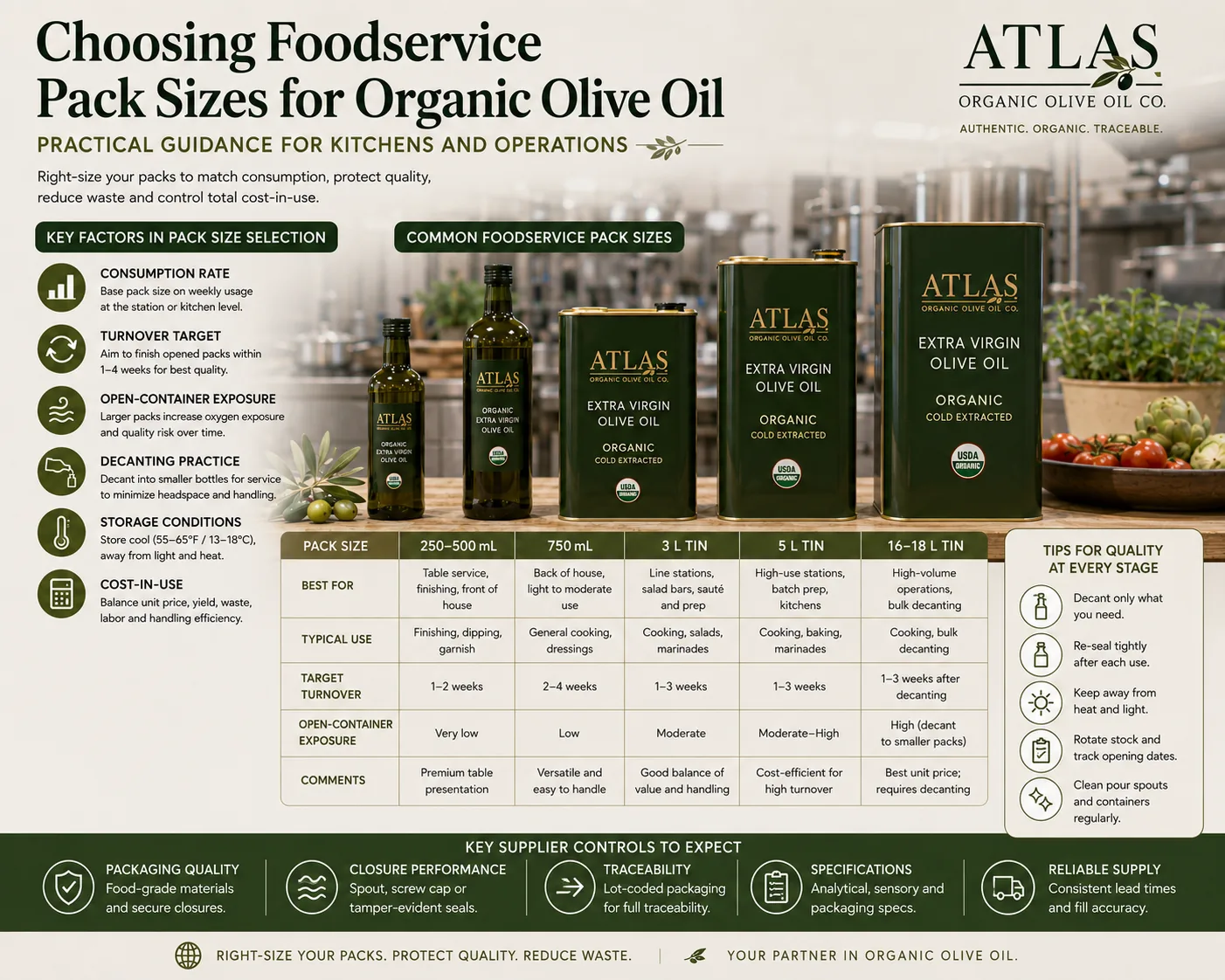
The best foodservice pack is the one a kitchen can use fast enough while protecting quality and controlling cost. Large containers reduce packaging per liter but can create long open exposure if turnover is slow.
Packaging has to fit the way the kitchen actually works. Light, oxygen, closure performance, storage location, refill practices and turnover all influence the condition of the oil after the original container is opened.
The practical objective is not to buy the largest pack at the lowest apparent unit cost. It is to select a format that each outlet or station can handle, store and consume efficiently while maintaining lot control and product quality.
1. Start with the decision framework
Before choosing a pack size, measure real consumption. The brief should state weekly usage by outlet or station, number of operating locations, intended use, back-of-house storage conditions, serving method, delivery frequency, available storage space and required organic documentation.
- Measure actual weekly consumption by station or outlet before sizing packs.
- Keep reserve stock cool and dark and decant only through controlled, clean procedures if local policy permits.
- Use smaller packs for low-turn finishing applications and larger formats for high-turn cooking, production or commissary use.
- Include closure design, ease of pouring and spill control in the pack decision, not only net volume.
One restaurant group may need more than one pack format. A central commissary using oil quickly can justify a larger container, while a finishing station serving a small number of portions may perform better with a smaller unit.
A useful specification therefore separates the olive-oil category and quality requirements from the operational pack-size requirement while keeping both tied to the same approved product and lot-control system.
2. Measure consumption before choosing pack size
Weekly or daily usage is one of the strongest pack-sizing inputs. Purchasing records alone can be misleading if they combine reserve inventory, multiple outlets or different applications.
Measure how much oil is actually consumed at the point of use. A frying or high-volume preparation station can have a very different drawdown from a finishing, salad or table-service application.
Usage should ideally be reviewed across representative busy and slower periods. A pack selected only from peak-season consumption may turn too slowly during quieter months.
For multi-unit operators, consumption can also vary substantially by location. A single chain-wide pack size may simplify procurement but may not be the most effective operational format for every outlet.
3. When smaller packs can make sense
Smaller packs can be useful for low-volume stations, finishing applications, premium olive-oil programs and kitchens where opened product would otherwise remain in use for an extended period.
They can also simplify physical handling and reduce the amount of product exposed each time a new container is opened.
The trade-off is usually more packaging and more individual units to receive, store and manage. Buyers should compare those costs against the operational benefits of faster turnover.
For premium finishing oils, the additional packaging cost may be justified if smaller units help preserve the intended sensory profile throughout normal use.
4. When larger packs can make sense
Larger packs can be efficient in high-volume kitchens, commissaries and manufacturing-style foodservice operations where the oil is consumed rapidly.
Fewer individual containers can reduce packaging per liter and may simplify inbound handling when the site has enough storage and appropriate dispensing procedures.
The format becomes less attractive if it remains partly filled for too long, is difficult for staff to lift or pour safely, or requires repeated uncontrolled decanting into smaller service containers.
A large package should therefore be selected because the kitchen can use it efficiently, not simply because its invoice price per liter is lower.
5. Consider time after opening
Opening a container changes the use environment. Repeated access, partial headspace, warm storage and frequent pouring can create conditions different from those of the sealed reserve stock.
A practical pack should be consumed within a reasonable operational period for the site. There is no single universal open-container time that applies to every oil, closure and kitchen.
Buyers should instead observe actual turnover and include opened-pack handling in their internal quality procedures.
If a container repeatedly remains in service far longer than expected, the correct response may be to reduce pack size or adjust delivery frequency rather than relying on the lower unit cost of the larger format.
6. Control decanting and refill practices
Some kitchens transfer oil from reserve packaging into smaller working containers. Where local policy and the operation's food-safety system permit that practice, the procedure should be controlled.
Refill containers should be suitable for food contact, clean, dry and clearly identified. Mixing new oil into unidentified residual oil can complicate both quality control and lot traceability.
Staff should avoid leaving decanted oil in open vessels or unprotected containers near the cooking line. A practical closure or dispensing system can improve both portion control and protection.
If lot-level traceability is required at the outlet, the operation should define how the original supplier lot remains connected to the working container.
7. Practical workflow
Move from consumption measurement to commercial approval in controlled stages. First, understand actual usage. Second, test candidate pack sizes in the real kitchen. Third, verify storage and dispensing. Finally, standardize the format and receiving checks.
- Measure real consumption. Record weekly usage by outlet, station and major application rather than relying only on total purchasing volume.
- Define the oil's role. Separate finishing, dressing, cooking, production and commissary uses where their turnover patterns differ.
- Shortlist practical pack sizes. Consider handling, storage, closure, pouring, refill practices and expected time after opening.
- Pilot the pack in service. Observe real staff handling, product turnover, residual oil and storage location.
- Review documents. Confirm lot identity, analytical results, organic status, traceability and required destination records.
- Confirm reserve-stock controls. Define where unopened inventory is stored and how FIFO or FEFO is maintained.
- Compare cost-in-use. Include waste, residual oil, labor, spills and packaging—not only price per liter.
- Define release and change control. Decide who approves a different pack size, closure, supplier or handling procedure.
8. Separate reserve stock from working stock
Unopened reserve inventory and actively used oil often experience very different conditions. Reserve stock should be stored away from direct light, unnecessary heat and other avoidable stress.
Working containers, by contrast, may be positioned close to grills, ovens, fryers or hot preparation areas. Convenience should be balanced against exposure.
If a particular station requires oil nearby, smaller working quantities can sometimes reduce the amount exposed to the hottest environment while reserve stock remains in a more protected location.
Storage rules should also ensure older reserve stock is used before newer deliveries where the operation's inventory policy requires FIFO or FEFO.
9. Keep working containers away from unnecessary heat
Foodservice kitchens are naturally warm environments, but oil does not need to be stored directly beside a heat source merely because it is used there.
Repeated exposure to elevated temperatures can work against the quality the buyer paid to obtain. Practical station layout should therefore keep containers as protected as service speed allows.
Operators can also review whether the working container is larger than necessary. A smaller volume used and replenished more frequently may spend less total time in the hottest part of the kitchen.
10. Closure and dispensing matter
Package selection is more than choosing net quantity. The closure should work with the intended service pattern and help reduce spills, unnecessary exposure and uncontrolled pouring.
For high-frequency use, staff need a dispensing system that is practical enough that they do not routinely remove closures or improvise open containers.
For lower-volume finishing oils, a more controlled pour can also support portion consistency and help manage ingredient cost.
Closure changes should be included in supplier change control when they materially affect how the pack is opened, resealed or dispensed.
11. Compare cost-in-use, not only unit price
The largest package frequently has a lower packaging cost per liter, but that does not guarantee the lowest total operating cost.
Buyers can compare purchase price together with residual oil, spills, labor, container handling, storage space and any quality loss associated with slow turnover.
A smaller pack may carry a higher nominal price while producing less waste or better portion control at a low-volume station.
Multi-unit operators can benefit from analyzing cost-in-use by outlet type rather than assuming one format delivers the best economics everywhere.
12. Standardize where useful, segment where necessary
Standardization can simplify procurement, training and inventory control across a restaurant or hospitality group. However, different outlet types may have legitimately different turnover.
A high-volume city restaurant, hotel banquet kitchen and small café may not consume olive oil at comparable rates even when they share the same brand standard.
Buyers can standardize a small number of approved formats rather than forcing one pack size onto every operation.
Clear rules should identify which pack belongs to which usage profile so local teams do not switch formats solely on short-term price.
13. Quality controls that belong in the conversation
Extra virgin olive oil is defined through more than packaging or free acidity. Buyers should use the current applicable category standard, appropriate laboratory methods and, where required, organoleptic assessment.
- Set appropriate barrier and light-protection requirements.
- Validate closure and dispensing performance under real foodservice use.
- Match package size to realistic use after opening.
- Keep reserve inventory protected and apply documented rotation rules.
- Maintain lot identification through any permitted decanting procedure.
- Tie analytical and organic documentation to the actual commercial lot supplied.
Packaging helps protect the oil, but it cannot compensate for a nonconforming incoming lot. Category, sensory, organic, packaging and foodservice handling controls should remain connected but distinct.
14. Include receiving and outlet distribution in the plan
Case size, pallet configuration and individual-container weight can affect how easily product moves from central receiving to the final kitchen.
Multi-outlet programs should consider whether full cases are sent to each location, broken at a distribution center or allocated through another controlled process.
The pack should remain identifiable through that flow so outlets can trace the product back to the supplier lot if a quality or documentation question arises.
Receiving teams should also inspect seals, closures and obvious package damage before product is released into normal stock.
15. Common failure modes
Most foodservice-pack problems arise when purchasing optimizes container price without observing how the oil is actually used after delivery.
- Buying the largest pack solely for unit cost.
- Leaving decanted oil unlabeled or exposed.
- Storing working containers beside heat sources.
- Using one pack size across outlets with very different turnover.
- Refilling small containers without a defined cleaning or lot-control procedure.
- Selecting a closure that staff routinely leave open because it is inconvenient.
- Keeping slow-moving reserve stock behind newer deliveries.
- Ignoring spills, residual oil and labor when comparing package economics.
Corrective-action triggers should be based on objective evidence: damaged seals, broken traceability, abnormal sensory change, excessive open exposure, storage deviations, package failure or other documented handling issues.
The operating procedure should also define who can remove a pack from service, how questionable stock is identified and what information is retained for supplier review.
16. What to put in the purchase specification
A practical foodservice specification should describe not only the oil itself but also the pack and operational characteristics needed for reliable daily use.
17. Questions to ask a potential foodservice supplier
Supplier discussions should cover how the available package options fit the actual foodservice operation rather than simply which format has the lowest price.
- Which foodservice pack sizes are available for the approved oil?
- Which closures or dispensing formats are available?
- How are pack size and case configuration linked to the commercial lot?
- Which analytical and organic documents accompany each lot?
- Can multiple approved pack sizes be supplied under the same quality program?
- What pallet and case configurations are available for multi-outlet distribution?
- How are container, closure or case changes communicated?
- Can delivery frequency be aligned with the buyer's actual consumption and stock policy?
The objective is a repeatable foodservice program where pack size, outlet turnover, product quality, traceability and cost remain aligned across future deliveries.
18. Reference framework
For olive-oil category definitions, analytical methods and organoleptic assessment, use the current International Olive Council trade standard and methods together with applicable destination-market requirements.
Packaging and storage guidance consistently emphasizes limiting unnecessary light, oxygen and heat exposure. Commercial shelf life should still be validated for the actual oil, package, distribution route and storage conditions.
Foodservice pack selection should therefore be treated as an operating-system decision involving consumption rate, handling, closure performance, storage and inventory control rather than only a purchase-price comparison.
Next step
Turn this guide into a foodservice sourcing brief by listing your outlet count, weekly consumption by major application, preferred pack sizes, storage conditions, serving or decanting method, annual volume, destination, sensory target and required organic documentation.
Atlas can then compare suitable organic extra virgin olive-oil programs on the same commercial basis and help align pack size, closure, sensory profile, distribution, traceability and delivery frequency with your foodservice operation.