
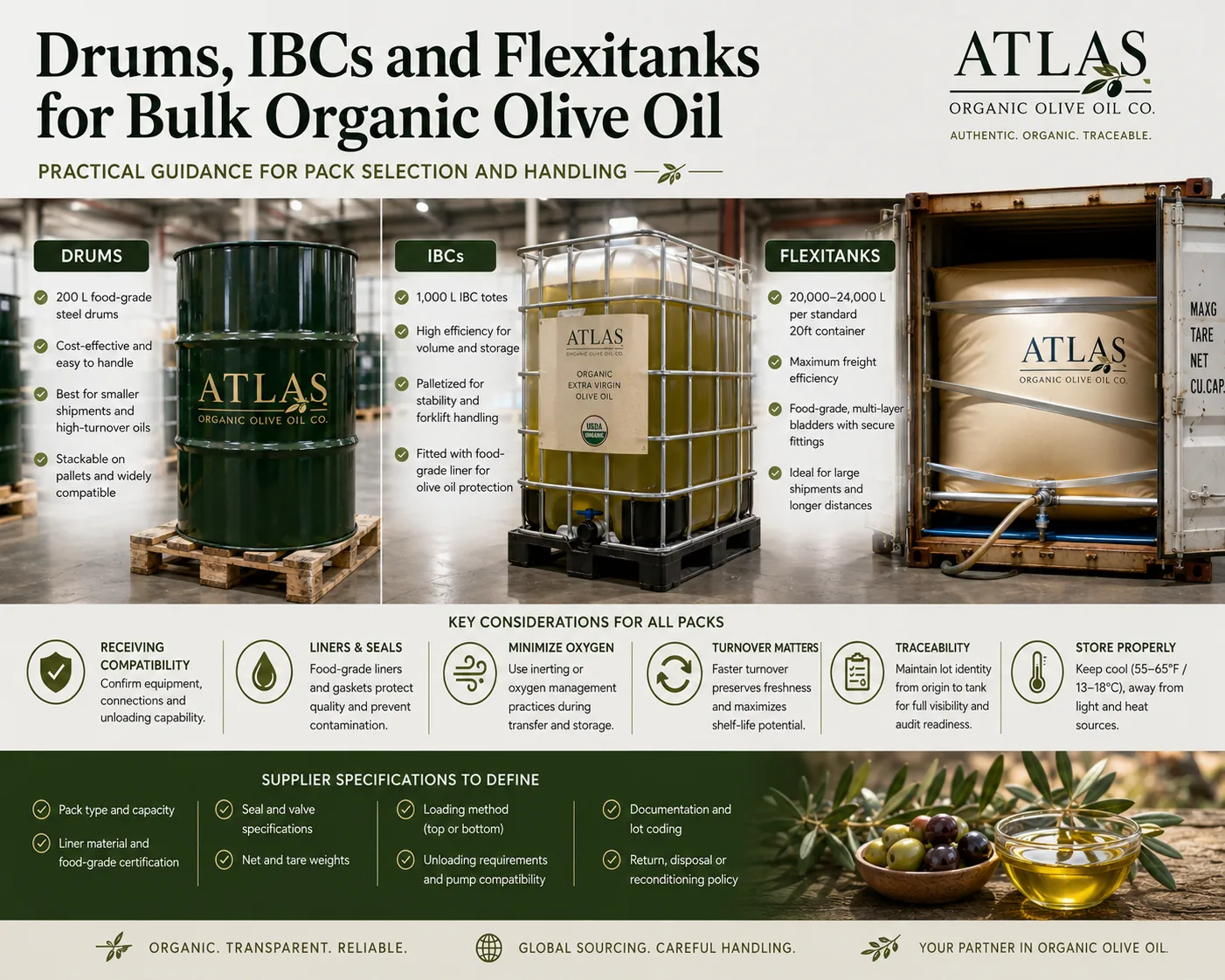
Bulk pack choice affects freight efficiency, oxygen exposure, unloading, traceability and the buyer's ability to use the oil quickly. There is no universally best container.
Bulk format determines how oil is loaded, protected, traced, stored and transferred. A high-volume container can reduce freight and handling per unit, but it can create problems if the receiving site lacks compatible pumps, hoses, storage capacity or sufficient consumption to empty the format promptly.
The practical objective is to select a format that matches the receiving operation. Container size, product-contact materials, seals, liners, unloading connections, storage space and inventory turnover should work together as one system.
1. Start with the decision framework
Before selecting drums, IBCs or flexitanks, document the physical receiving and commercial requirements. The brief should state annual volume, shipment size, delivery frequency, tank capacity, unloading equipment, warehouse constraints, consumption rate, destination, organic requirements and required quality documentation.
- Match pack size to receiving equipment, storage-tank capacity and consumption rate.
- Define liner, seal, cleanliness, food-contact and tamper-evidence requirements before shipment.
- Plan transfer to minimize unnecessary air pickup and preserve lot identity through receiving and storage.
- Confirm that the site's forklift, dock, hose, pump and connection arrangements are appropriate for the chosen bulk format.
The cheapest freight format is not automatically the lowest-cost operating option. Labor, unloading time, residual oil, warehouse space, handling risk, disposal, tank utilization and slow turnover can materially change the total commercial result.
A useful specification therefore separates the olive-oil category and quality requirements from the physical bulk-pack requirements while keeping both tied to the same lot and shipment documentation.
2. When drums can make sense
Drums can be practical for lower-volume programs, multiple customer allocations, trial shipments or facilities that need the incoming lot divided into manageable units.
Smaller individual units can make lot segregation easier and can reduce the operational impact of opening a very large container when daily consumption is modest. They can also be useful where the site does not have a large receiving tank.
The trade-off is greater handling per unit. More individual containers mean more seals, labels, movements and connection events to manage, which can increase labor and the number of opportunities for handling errors.
Buyers should define drum construction, liner where applicable, closure, food-contact requirements, tamper evidence, labeling and palletization before ordering.
3. When IBCs can make sense
IBCs can provide a middle ground between drums and large-volume flexitank shipments. They are often suitable for medium-volume users that want a larger unit while retaining individual container identity and forklift mobility.
An IBC can be connected directly to a controlled transfer system or used as a short-term operating container where the site's procedures allow it. The buyer should confirm valve compatibility, connection type and pump requirements in advance.
Because the container is larger than a drum, realistic consumption rate becomes more important. A partly used IBC held for a long period can create more headspace exposure and inventory-age concerns than a format that turns over rapidly.
Warehouse layout also matters. The site should define how full and empty units are moved, protected and identified without damaging valves, cages or product-contact parts.
4. When flexitanks can make sense
Flexitanks can be attractive for large-volume shipments where the buyer can receive a substantial quantity efficiently into appropriate storage. Their main commercial advantage is the ability to move a large bulk quantity in one shipping unit.
The receiving operation should be designed for that volume before purchase. Tank capacity, transfer rate, connection arrangement, staffing and contingency planning all need to support the unloading event.
A flexitank is not simply a larger IBC. It creates a different logistics and unloading process, and the buyer should understand responsibilities for installation, container suitability, liner integrity, discharge and shipment inspection.
Flexitanks work best where the receiving site can transfer the shipment into controlled storage without leaving the oil in a partially discharged state for an unnecessarily long period.
5. Confirm receiving compatibility before purchase
Bulk-format selection should begin at the receiving connection and work backward. The buyer should know which couplings, hoses, pumps and adapters are required before the shipment reaches the site.
Receiving procedures should identify where the container will be positioned, how connections are protected from contamination and how the operator verifies the destination tank before opening the product pathway.
For drums and IBCs, the facility should also determine whether each container is pumped individually, connected through a common manifold or transferred into a staging tank. Each approach creates different traceability and sanitation needs.
A format should not be purchased merely because a supplier can offer it. It should first be confirmed as operationally compatible with the buyer's equipment and procedures.
6. Define liners, seals and product-contact requirements
Product-contact surfaces should be suitable for the intended food use and agreed commercial program. Depending on the format, this can involve drum liners, IBC inner containers, flexitank liners, valves, closures and transfer fittings.
Seal or tamper-evidence requirements should also be specified. Seal numbers can support receiving verification when they are linked to shipment and lot documentation.
If the program has specific liner or material requirements, they should be written into the purchase specification rather than assumed to be standard across suppliers.
Damaged closures, valves, liners or external structures should trigger the site's receiving investigation before unloading proceeds.
7. Practical workflow
Move from bulk-format selection to receiving approval in controlled stages. First, confirm site capability. Second, agree the container specification. Third, validate unloading. Finally, define receiving and lot-control checks for future shipments.
- Write a one-page logistics brief. Include category, organic status, annual volume, shipment size, preferred format, destination, tank capacity and receiving equipment.
- Confirm physical compatibility. Review dock access, forklifts, container dimensions, hoses, pumps, couplings and storage capacity.
- Define container requirements. Agree food-contact materials, liners, closures, valves, seals and labeling.
- Review shipment documents. Confirm lot identity, analytical results, organic status, traceability and required logistics documentation.
- Inspect on arrival. Check shipment identity, seals, exterior condition and receiving readiness before opening or connecting.
- Transfer under controlled conditions. Minimize unnecessary splashing and maintain clear source-to-destination lot identity.
- Record residual and received quantity. Reconcile the transfer against shipment and receiving records where appropriate.
- Define release and change control. Decide who approves a new pack format, liner, valve, carrier or other material change.
8. Consider oxygen exposure during partial use
Pack size affects the amount of time a container can remain partly filled after opening. This becomes more important when the site draws directly from drums or IBCs rather than transferring the full quantity into a controlled tank.
A large container can be efficient when it is consumed quickly, but it may be less attractive when the same partially used unit remains in service for an extended period.
Buyers should therefore match container size to realistic drawdown rather than to maximum purchasing efficiency alone.
Where tank transfer or headspace management is part of the facility's quality system, those controls should be evaluated with the actual bulk format and transfer method.
9. Match container size to turnover
Turnover is one of the most practical format-selection criteria. A bulk package should normally be sized so the receiving operation can use or transfer the oil within a commercially appropriate period.
Drums can offer more flexibility for slower consumption because only one unit needs to be opened at a time. IBCs may fit medium-volume operations, while flexitanks generally make more sense where high-volume storage and rapid transfer are available.
The correct comparison is therefore not simply freight cost per liter. Buyers should consider residual oil, handling labor, warehouse occupancy, inventory age and the operational cost of managing partly used units.
10. Preserve lot identity through unloading
Every bulk unit should remain linked to the commercial supplier lot. Drums and IBCs may carry individual container identifiers, while a flexitank shipment may represent one large bulk lot or another defined lot structure.
When oil is transferred into an internal tank, the tank record should preserve the parent supplier lot rather than replacing it with an unrelated internal identifier that cannot be traced backward.
If multiple drums or IBCs from different lots are consolidated, the resulting tank should retain parent-child traceability to all contributing lots and quantities.
This linkage supports quality review, organic certification, complaints, withdrawals and future inventory reconciliation.
11. Include warehouse handling in the decision
Bulk containers occupy space and require safe physical movement. The buyer should consider dock capacity, forklift access, staging areas and how empty or partially used units will be controlled.
Drums can create more individual handling events, while IBCs require sufficient floor space and suitable lifting equipment. Flexitanks shift more of the emphasis toward container positioning and rapid transfer rather than warehouse storage of the incoming package itself.
Storage areas should protect the oil from unnecessary heat, direct sunlight and damage to valves, closures or liners.
12. Quality controls that belong in the conversation
Extra virgin olive oil is defined through more than bulk format or free acidity. Buyers should use the current applicable category standard, appropriate laboratory methods and, where required, organoleptic assessment.
- Confirm unloading compatibility before purchase.
- Specify food-contact materials, cleanliness, seals and liners.
- Control oxygen pickup and preserve lot identity during transfer.
- Match pack size to actual consumption and tank capacity.
- Inspect valves, closures and external condition before unloading.
- Keep organic, analytical and transport records tied to the same commercial lot.
Bulk packaging helps protect and move the incoming oil, but the chosen format cannot compensate for poor quality at source or poor storage after receipt.
13. Common failure modes
Most bulk-format problems come from selecting the package before understanding the receiving process or actual consumption rate.
- Ordering a format the site cannot unload safely or efficiently.
- Discovering incompatible valves, couplings or pump capacity after arrival.
- Breaking lot traceability during tank consolidation.
- Using a large pack that remains partly filled for too long.
- Failing to define liner, food-contact or seal requirements before shipment.
- Accepting damaged valves, closures or container structures without investigation.
- Choosing the lowest freight cost while ignoring warehouse and handling costs.
- Changing bulk format without revalidating the receiving and storage process.
Corrective-action triggers should be based on objective evidence: damaged seals, liner or valve problems, shipment mismatch, broken traceability, out-of-specification quality results, contamination concerns or documented unloading deviations.
The receiving procedure should define who can place the shipment on hold, who contacts the supplier or carrier and what evidence is required before unloading resumes.
14. What to put in the purchase specification
A practical bulk specification should describe both the olive oil and the physical delivery format in enough detail that the receiving team knows what to expect.
15. Questions to ask a potential bulk olive-oil supplier
Supplier discussions should cover both the oil and the physical delivery system. A commercially suitable oil can still create operational problems if the pack format does not match the receiving site.
- Which drum, IBC and flexitank configurations are available?
- Which food-contact liners, inner containers and valve systems are used?
- What seal or tamper-evidence system is provided?
- Which connection details should the buyer confirm before delivery?
- How is each bulk unit or shipment linked to the commercial lot?
- Which analytical and organic documents accompany the shipment?
- What receiving or unloading information can be supplied before dispatch?
- How are bulk-format, liner, valve or logistics changes communicated?
The objective is a repeatable bulk-delivery program rather than a one-time freight choice. Clear container specifications, compatible receiving equipment and lot-specific documentation make future shipments easier to manage.
16. Reference framework
Bulk-format selection should be based on the receiving site's actual equipment, tank capacity, sanitation program, turnover and logistics requirements. Food-contact materials, seals and transport conditions should be controlled under the buyer's applicable food-safety and quality systems.
For olive-oil category definitions, analytical methods and organoleptic assessment, use the current International Olive Council trade standard and methods together with applicable destination-market requirements.
Organic identity and traceability should be preserved from supplier lot through container identification, receiving, transfer and internal storage.
Next step
Turn this guide into a bulk sourcing brief by listing your annual volume, shipment size, preferred format, receiving equipment, tank capacity, consumption rate, destination, quality specification and organic documentation requirements.
Atlas can then compare suitable organic extra virgin olive-oil programs on the same commercial basis and help align drums, IBCs or flexitanks with your receiving system, turnover, traceability, quality requirements and supply planning.