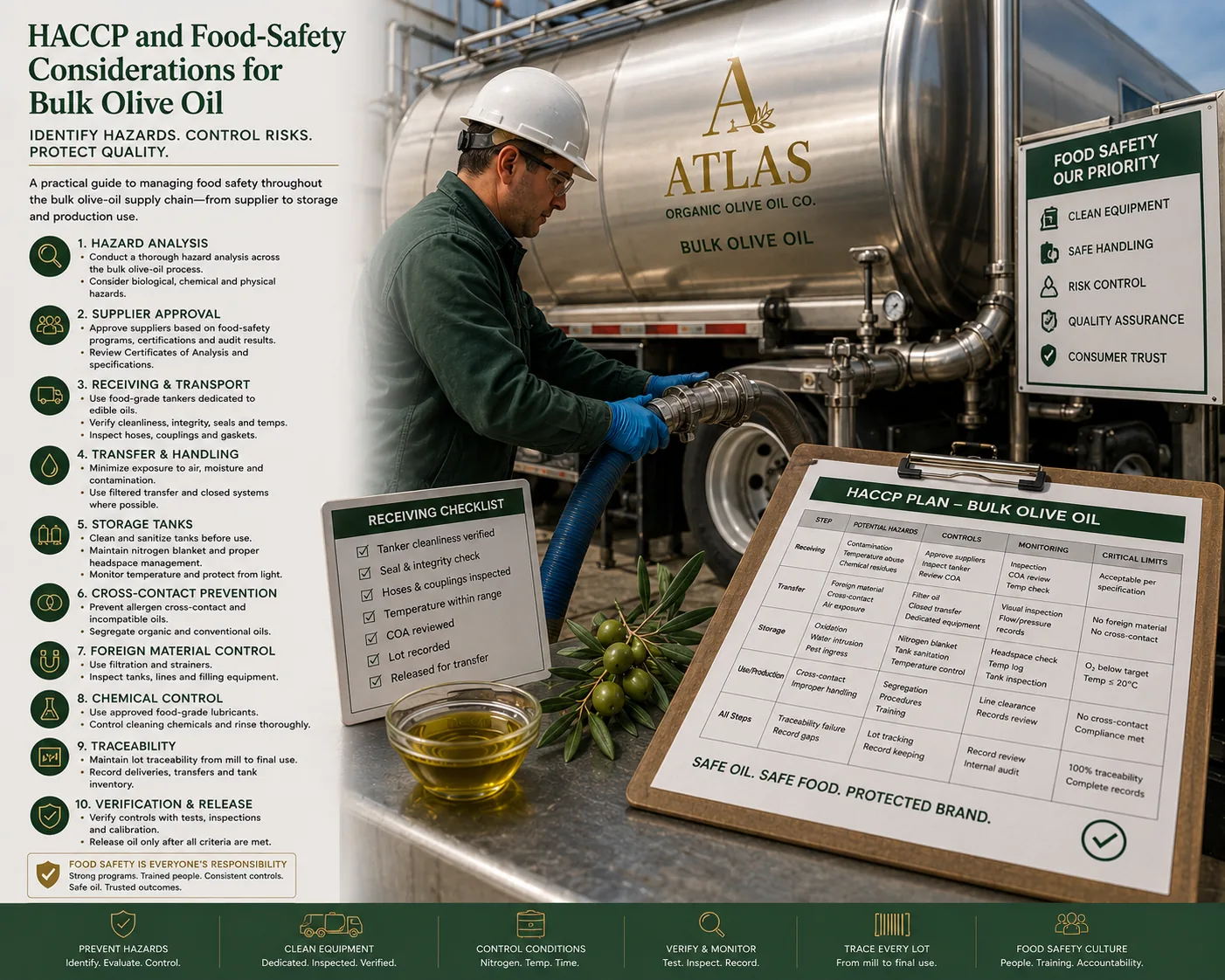
Olive oil is a low-moisture food, but bulk handling still requires a food-safety system covering receiving, tank cleanliness, allergens or cross-contact where relevant, foreign material, chemicals and transportation hygiene.
Olive-oil quality controls do not replace a food-safety system. Bulk receipt, unloading, transfer and storage still need hazard analysis, sanitation, supplier approval, traceability and transportation controls appropriate to the facility. A certificate of analysis can support quality release, but it does not by itself confirm that every food-safety hazard in the receiving and storage process is controlled.
The practical objective is to integrate the incoming oil into the site's existing food-safety plan. The receiving team, quality department, warehouse, sanitation program and supplier should all work from the same definition of an acceptable shipment and an approved transfer.
1. Start with the decision framework
Before approving a bulk program, define both the commercial requirement and the receiving process. The brief should state the olive-oil category, organic status, annual and trial volumes, bulk format, unloading method, storage tank, intended application, destination market and required quality and food-safety documentation.
- Include olive-oil receipt, transfer and storage in the site's hazard analysis and prerequisite programs.
- Control tanker, flexitank, hose, pump and receiving-tank status before transfer.
- Use supplier approval, shipment identification, seal checks and documented release controls appropriate to the facility.
- Keep quality-release criteria and food-safety release criteria clearly defined.
The exact controls should come from the facility's own hazard analysis rather than from a generic assumption that all bulk olive-oil programs have identical risks. Equipment design, shared lines, previous cargoes, downstream products and local regulatory requirements can all affect the control plan.
A useful purchasing specification separates olive-oil category and sensory requirements from food-safety and transportation requirements. Both matter, but they answer different questions and may require different evidence.
2. Include bulk olive oil in the site hazard analysis
Low water activity changes the microbial risk profile, but it does not remove the need for a documented hazard assessment. The facility should consider the hazards reasonably associated with the ingredient, supplier, transportation route, receiving equipment and downstream process.
Depending on the operation, the review may consider biological, chemical and physical hazards as well as allergen or cross-contact concerns where shared transportation or equipment makes them relevant.
The hazard analysis should also identify which risks are controlled through supplier programs, sanitation procedures, receiving checks, preventive controls, operational procedures or other elements of the site's food-safety system.
3. Make receiving a controlled checkpoint
Bulk receiving is the point where supplier documentation and the physical shipment meet. The receiving team should confirm that the material arriving at the site matches the approved product, supplier and shipment records before unloading begins.
Depending on the program, checks can include lot identity, shipment documentation, seal numbers, container or tanker condition, delivery temperature where relevant, product description and confirmation that the designated receiving tank is ready.
If any required information is missing or inconsistent, the site's procedure should define whether the shipment is placed on hold, sampled, investigated or rejected before connection to the receiving system.
4. Review transportation and previous-load controls
Tankers, flexitanks, IBCs and other bulk systems should be appropriate for food-contact use and managed under an approved transportation-hygiene program. The required level of previous-load, cleaning or seal documentation depends on the buyer's risk assessment and transport format.
Where tankers or transfer systems are reused, buyers may require information demonstrating that the equipment was suitable and cleaned according to the agreed program before loading the olive oil.
Seal integrity and shipment identity should remain linked to the commercial documents so that unexpected openings, substitutions or transport deviations can be investigated before unloading.
5. Practical workflow
A controlled workflow should connect supplier approval, receiving, transfer, storage and release. Each stage should preserve lot identity and prevent a questionable shipment from moving into unrestricted production use.
- Write a one-page bulk brief. Include category, organic status, bulk format, annual volume, destination, unloading method, storage system and required documentation.
- Approve the supplier and transport route. Review the supplier's quality and food-safety documentation together with the planned bulk shipping format.
- Review pre-arrival documents. Confirm lot identity, certificate of analysis, organic status, shipment records and any agreed sanitation or transport documentation.
- Inspect the shipment. Check seals, container or tanker condition, identification and any required receiving criteria before connection.
- Verify transfer readiness. Confirm hose, pump, valve, line and receiving-tank status before unloading.
- Transfer under controlled conditions. Follow the site's approved unloading and lot-identification procedure.
- Complete release checks. Confirm that required food-safety, quality and traceability evidence is complete before unrestricted use.
- Maintain change control. Reassess material changes involving supplier, transport format, cleaning program, transfer equipment, storage tank or product specification.
6. Control tank, hose and transfer-system sanitation
The cleanliness of a tanker is only one part of the transfer pathway. Hoses, pumps, manifolds, valves and receiving tanks can also introduce contamination if their status is not controlled before use.
Cleaning procedures should define the equipment covered, cleaning method, verification or inspection requirements, chemical controls and release status before the system is placed back into service.
Shared systems deserve particular attention. If the same equipment handles different oils, ingredients or products, the facility should determine whether cleaning and sequencing controls are needed to prevent unacceptable carryover or cross-contact.
7. Evaluate allergens and cross-contact where relevant
Olive oil itself should not be treated as an automatic allergen hazard simply because it enters a shared food plant. The relevant question is whether the transport, transfer or storage system creates a realistic cross-contact pathway with allergenic or otherwise restricted materials.
Where shared equipment or previous cargoes create such a possibility, the site's hazard analysis should define the necessary segregation, cleaning, verification or supplier controls.
The same approach applies to organic integrity. If organic and non-organic oils share tanks or transfer equipment, the operating program should preserve identity and prevent unintended mixing in accordance with the site's certification controls.
8. Address foreign-material and chemical risks
Physical contamination can arise from damaged seals, transfer equipment, maintenance activity or inappropriate handling. Equipment inspection and preventive maintenance therefore support both operational reliability and food-safety control.
Chemical risks can include unsuitable cleaning agents, lubricant contamination, prior cargo residues or incorrect use of maintenance chemicals. Food-contact chemicals should be controlled within the site's approved chemical program.
If filters, strainers or other physical controls are part of the process, their function, inspection and maintenance should be defined by the facility rather than assumed to compensate for weak upstream hygiene.
9. Keep quality and food-safety release criteria distinct
Extra virgin olive oil is defined through more than free acidity. Buyers should use the current applicable category standard, appropriate analytical methods and, where required, organoleptic assessment. These are important quality controls, but they should not be confused with the site's food-safety hazard controls.
- Include olive oil in the site hazard analysis.
- Verify transport and transfer-equipment status before unloading.
- Maintain food-contact and sanitation controls for tanks, hoses, pumps and lines.
- Keep quality release and food-safety release criteria clearly defined.
- Link all shipment, analytical, organic and receiving records to the commercial lot.
A shipment may meet the buyer's acidity, peroxide and sensory specification but still require a food-safety hold because of a broken seal, unacceptable transport history or sanitation deviation. The reverse can also occur: a hygienically acceptable delivery can still fail the commercial quality specification.
10. Preserve traceability through tanks and transfers
Lot identity should remain clear after unloading. If the supplier lot is transferred into a receiving tank and assigned a new internal identifier, the two numbers should remain cross-referenced.
When one tank supplies several production or packing lots, parent-child traceability should show where the incoming oil was used. When several approved lots are consolidated, the resulting tank or production lot should remain traceable to its contributing source lots.
This record structure supports food-safety investigation, organic audit, customer documentation, quality complaints and any future recall or withdrawal activity.
11. Common failure modes
Most failures occur when bulk oil is treated as a simple commodity transfer rather than as a controlled food-ingredient receiving operation.
- Assuming low moisture eliminates all food-safety responsibilities.
- Unloading before required shipment or seal checks are complete.
- Using shared transfer equipment without defined cleaning controls.
- Connecting a shipment to the wrong or uncleared receiving tank.
- Treating quality defects and food-safety hazards as interchangeable.
- Failing to preserve supplier-lot identity after tank transfer.
- Using cleaning or maintenance chemicals without adequate food-contact control.
- Changing transport or receiving arrangements without reassessing the hazard analysis.
Corrective-action triggers should be based on objective evidence: broken seals, unacceptable transport history, sanitation failures, missing traceability, foreign material, chemical contamination concerns, out-of-specification quality results or documented receiving deviations.
The facility should define who places the shipment or tank on hold, who investigates the deviation and what evidence is required before the oil can be released, reworked, returned or otherwise dispositioned.
12. What to put in the purchase specification
A useful bulk specification should cover not only the olive oil itself but also the documentation and transport conditions needed for controlled receiving.
13. Questions to ask a bulk olive-oil supplier
Supplier approval should cover both olive-oil quality and the controls supporting safe bulk transportation and traceable delivery.
- Which food-safety system and supplier-approval documents are available?
- How is each bulk shipment linked to the commercial production lot?
- Which analytical and organic documents accompany each lot?
- What tanker, flexitank, IBC or other bulk formats are available?
- How are cleaning status and previous-load requirements managed where applicable?
- How are seal numbers and shipment identity documented?
- What process is followed if a transport or sanitation deviation occurs?
- How are material changes to the supply or transport program communicated?
The goal is a repeatable receiving program rather than a one-time document review. Clear supplier controls, clean transport equipment, lot-specific documentation and defined hold-and-release procedures make bulk deliveries easier to manage.
14. Reference framework
Food-safety controls should be based on the facility's current hazard analysis, prerequisite programs and applicable destination-market food-safety requirements. The exact preventive or operational controls depend on the site, supply chain and downstream process.
For olive-oil category definitions, analytical methods and organoleptic assessment, use the current International Olive Council trade standard and methods together with applicable destination-market rules.
Organic certification, food safety and olive-oil category compliance should be managed as connected but distinct systems, each supported by the documentation relevant to its purpose.
Next step
Turn this guide into a bulk sourcing brief by listing your olive-oil category, annual volume, bulk format, destination, unloading system, receiving-tank setup, quality specification, organic requirements and required food-safety documentation.
Atlas can then compare suitable organic extra virgin olive-oil programs on the same commercial basis and help align lot documentation, bulk format, traceability, quality requirements and supply planning with your receiving and food-safety system.