
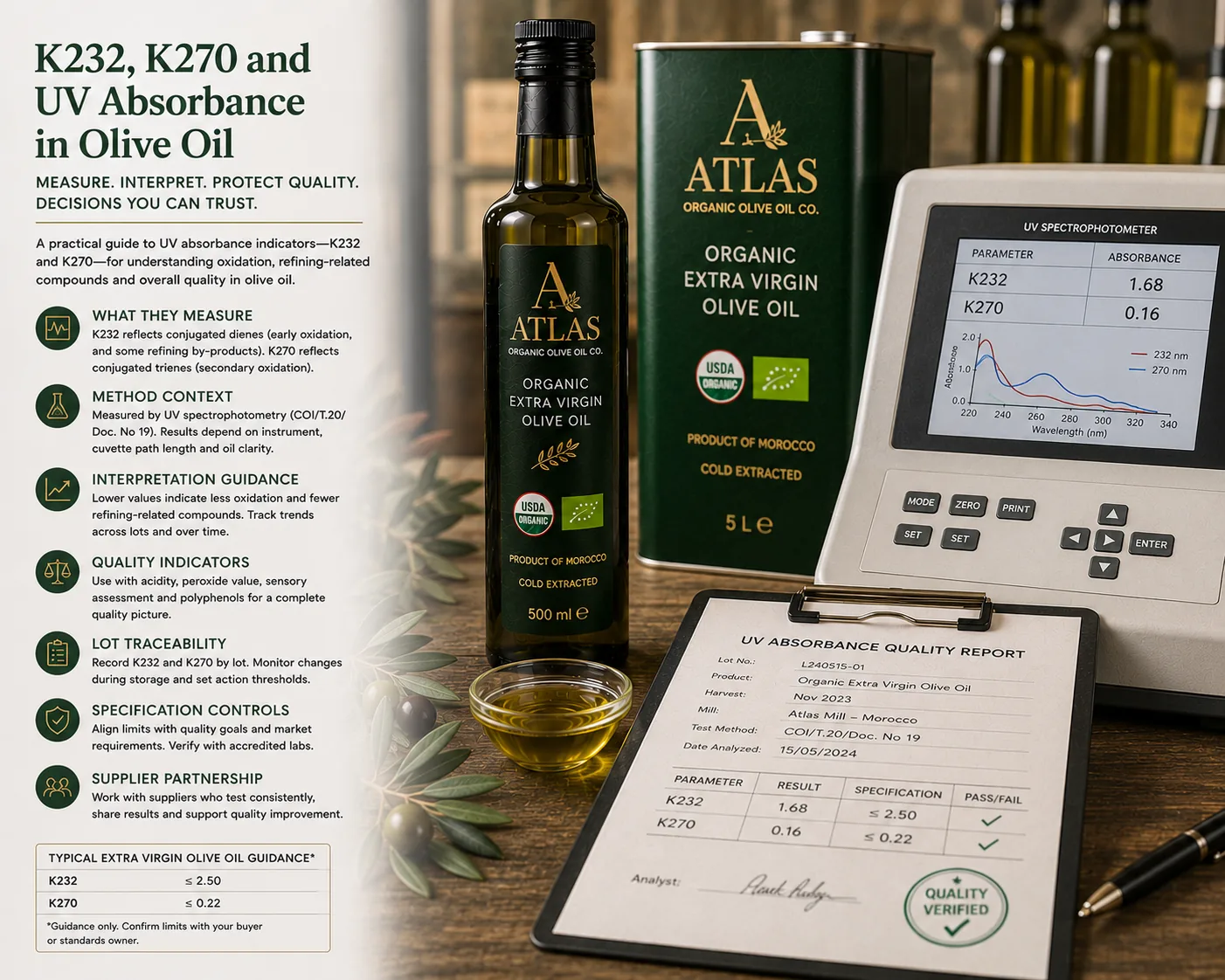
Specific UV absorbance measurements such as K232 and K270 help characterize oxidation and refining-related changes within olive-oil standards. They are technical indicators, not consumer flavor descriptors.
Analytical numbers are meaningful only in context: lot identity, sampling, analytical method, category standard, sensory condition and storage history. A result that appears acceptable in isolation should not automatically override contradictory evidence from other quality parameters or organoleptic assessment.
The practical objective is not to select an oil because one number looks especially low. It is to define an analytical program that confirms whether a specific lot complies with the intended olive-oil category and remains suitable for the buyer's application, destination market and commercial specification.
1. Start with the decision framework
Before requesting samples or comparing certificates of analysis, define the category and decision the test results need to support. The brief should state the olive-oil category, applicable destination rules, required test method, lot-release criteria, internal purchasing targets, pack format, intended application and required organic documentation.
- Specify the governing test method and category limits rather than copying numbers from an old certificate of analysis.
- Interpret UV results together with free acidity, peroxide value, sensory condition and other applicable authenticity or quality tests.
- Link every analytical result to the actual commercial lot being purchased.
- Investigate unusual trends or conflicting results instead of averaging away a potentially nonconforming lot.
Buyers should also separate regulatory or category limits from tighter internal commercial targets. A purchasing program may choose an internal operating range that is more conservative than the legal maximum, but that internal target should be identified clearly as a buyer requirement rather than presented as the category definition.
A useful specification should therefore distinguish between mandatory category criteria, contractual release limits, internal trend targets and typical values associated with a particular origin, harvest or supplier program.
2. What K232 and K270 represent
K232 and K270 are specific ultraviolet absorbance measurements obtained under defined analytical conditions. They are used because chemical changes in oils can alter absorption at particular UV wavelengths.
In practical quality control, K232 is commonly considered alongside indicators associated with primary oxidation-related changes, while K270 can provide additional information relevant to more advanced oxidation-related or refining-related changes within the analytical framework used for olive oil.
These measurements should not be translated directly into statements such as “better tasting,” “more fruity” or “fresher.” Two oils can have different sensory profiles while both meeting the applicable UV absorbance criteria, and sensory defects can exist even when an isolated UV value appears acceptable.
3. Interpret UV absorbance in context
The strongest analytical decisions come from a group of mutually supporting results rather than one number. UV absorbance should therefore be considered within the complete category and quality-control framework.
Free acidity can provide information related to hydrolytic degradation and fruit or processing condition, while peroxide value is another commonly used oxidation-related indicator. UV absorbance adds different information and should complement, rather than replace, those measurements.
Organoleptic assessment is also essential where required by the applicable category standard. Laboratory chemistry cannot be used to infer all sensory characteristics or to dismiss a confirmed sensory defect.
Depending on the destination market, supplier-risk profile and commercial program, additional authenticity or quality tests may also be relevant.
4. Practical workflow
Move from supplier documentation to lot approval in controlled steps. First, identify the governing standard and analytical methods. Second, verify that results are tied to the correct lot. Third, review the complete quality picture. Finally, trend future lots so unusual movement can be investigated early.
- Write a one-page analytical brief. Include olive-oil category, organic status, destination market, required parameters, methods, release limits, pack, volume and timing.
- Review the certificate of analysis. Confirm lot number, sample identity, test date, laboratory, method references and all parameters required by the purchase specification.
- Confirm sampling integrity. Make sure the tested sample is representative of the commercial lot and that the sampling pathway is documented where the decision warrants it.
- Review results together. Compare K232 and K270 with the other analytical and sensory criteria required for the relevant olive-oil category.
- Investigate anomalies. Review unexpected trends, conflicting results, unusual laboratory variation or values approaching contractual limits.
- Evaluate storage history where relevant. Consider age, heat, light and oxygen exposure if later testing differs significantly from the original release profile.
- Retain reference samples. Keep appropriately identified samples where they can support later comparisons or quality investigations.
- Define release and change control. Decide who approves results, method changes, laboratories, new suppliers or changes to analytical limits.
5. Method references matter
Analytical values should be interpreted against the method used to generate them. A specification that lists only “K232” or “K270” without identifying the applicable standard or method can create ambiguity between supplier and buyer.
Laboratories should use recognized current methods appropriate to the category and commercial decision. Where the purchasing specification references a particular regulatory or international standard, the method language should remain consistent with that framework.
When historical results are compared with new results, buyers should confirm that method changes have not created an artificial trend. A shift in analytical method, laboratory procedure or reporting convention can complicate comparisons if it is not documented.
6. Sampling is part of the analytical result
Even a well-run laboratory test is only as useful as the sample submitted. Buyers should therefore treat sampling as part of the quality-control system rather than an administrative step.
The sample should be identifiable to the lot, tank, container or shipment being evaluated. If a bulk lot is sampled from an unrepresentative location, the result may not accurately characterize the complete commercial lot.
Sampling records become especially important when a result is disputed, when different laboratories produce materially different findings or when a later retained sample is used during investigation.
7. Use trends to identify change
Individual lots should be judged against the applicable release criteria, but trend data can provide additional insight into supplier consistency and storage behavior.
A gradual movement in UV absorbance, peroxide value or another related parameter can prompt investigation before a formal limit is exceeded. Trend review can therefore support proactive supplier discussions and inventory management.
Trends should not be interpreted without context. Harvest variation, origin, storage duration, laboratory changes and sampling differences can all influence the pattern seen in the data.
The goal is not to reject normal agricultural variability. It is to identify changes that are unusual for the approved commercial program and worthy of review.
8. Quality controls that belong in the conversation
Extra virgin olive oil is defined through more than free acidity or UV absorbance. Buyers should use the current applicable category standard, appropriate laboratory methods and, where required, organoleptic assessment.
- Link every result to the actual shipped or stored lot.
- Use recognized current methods and laboratories appropriate to the decision.
- Trend multiple quality indicators instead of relying on one number.
- Maintain retained samples where commercially justified.
- Keep analytical, sensory, organic and traceability documents connected through the lot-control system.
For commercial programs, internal targets may also describe the sensory style needed by the brand or application. Analytical compliance establishes part of the quality picture; it does not automatically define fruitiness, bitterness, pungency or overall consumer preference.
9. Storage history can affect later results
An analytical result describes the sample at a particular point in time. Subsequent exposure to oxygen, heat, light or extended storage can change the quality profile of the oil.
If later testing differs from the original supplier certificate, investigators should review tank conditions, transfer history, package protection, inventory age and other storage factors before assuming that one of the laboratories is incorrect.
Retained samples from receipt can help distinguish an incoming-lot issue from a deterioration problem introduced during downstream storage or handling.
10. Common failure modes
Most analytical-control failures result from missing context rather than a lack of numerical data. A long certificate of analysis can still be weak if the lot, method or decision criteria are unclear.
- Using outdated limits without checking the current applicable standard.
- Explaining K-values as direct measures of taste or consumer quality.
- Ignoring method or laboratory differences when comparing results.
- Accepting a certificate of analysis that is not clearly linked to the shipped lot.
- Looking at K232 or K270 without reviewing the rest of the category requirements.
- Averaging several results in a way that hides a potentially nonconforming lot.
- Ignoring storage history when repeat testing changes materially.
- Treating internal purchasing targets as though they were universal legal limits.
Corrective-action triggers should be based on objective evidence: out-of-specification results, unexplained trends, conflicting laboratory findings, sensory defects, broken traceability, temperature excursions or documented sampling and handling deviations.
The quality system should also define who places a lot on hold, when retesting is appropriate, whether an independent laboratory is needed and what evidence is required before the lot can be released.
11. What to put in the purchase specification
A practical purchase specification should state not only which analytical parameters are required, but also the category, method, lot linkage and decision rules behind those results.
12. Investigate conflicting results systematically
When a buyer and supplier receive materially different analytical results, the first response should be to review sample identity, lot linkage, sampling procedure, test method, laboratory and timing.
Testing the same commercial lot at different points in its history can produce legitimately different results if storage or handling conditions have changed. Likewise, samples drawn from different parts of a poorly mixed or poorly identified bulk system may not be directly comparable.
A defined dispute procedure can specify when duplicate testing, retained samples or an agreed independent laboratory are used. This reduces the risk of making release decisions through informal argument rather than documented evidence.
13. Reference framework
For olive-oil category definitions, UV absorbance criteria, analytical methods and organoleptic assessment, use the current International Olive Council trade standard and methods together with applicable destination-market requirements.
Buyers should confirm the current consolidated requirements applicable to the specific commercial destination before setting release limits. Historical certificates or old internal specifications should not be assumed to represent the current regulatory framework.
14. Questions to ask a potential olive-oil supplier
Supplier qualification should cover both the numerical results and the system behind those results. Method consistency, lot linkage and responsive investigation procedures can be as important as the first certificate of analysis.
- Which analytical methods are used for K232, K270 and related quality parameters?
- Which laboratory performs routine release testing?
- How is each certificate of analysis linked to the commercial lot?
- Which complementary category and authenticity tests are routinely reported?
- How are retained samples identified and stored?
- How are unexpected analytical trends investigated?
- What procedure is used if buyer and supplier laboratory results conflict?
- How are method, laboratory, origin, harvest or specification changes communicated?
The objective is a repeatable quality-control program rather than a one-time certificate review. Clear methods, lot-specific results, retained samples, trend data and agreed change control make future shipments easier to evaluate.
Next step
Turn this guide into a sourcing and analytical brief by listing your required olive-oil category, destination market, application, annual volume, pack format, analytical parameters, internal targets, sensory requirements and organic documentation.
Atlas can then compare suitable organic olive-oil programs on the same commercial basis and help align lot-specific certificates of analysis, sensory style, traceability, packaging and supplier documentation with your quality-control requirements.