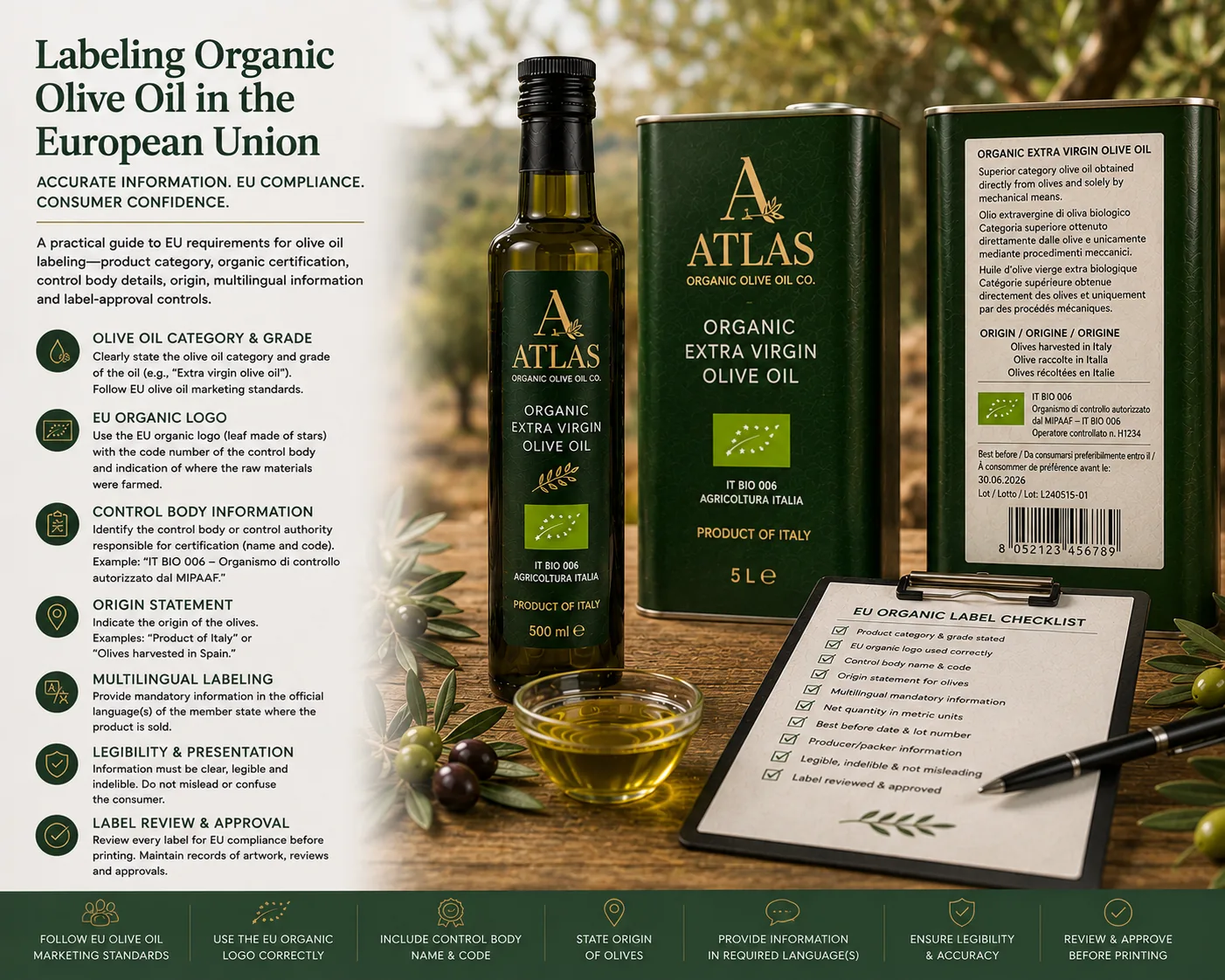
EU olive-oil marketing standards and organic rules create overlapping requirements for category designation, characteristics, presentation and organic status. Label review should use current consolidated rules and the requirements of the specific country where the product will be sold.
Regulatory status is jurisdiction-specific and changes over time. Use current primary rules and competent regulatory, certification or legal review before printing labels, approving claims or publishing health-related statements. This page is intended as commercial sourcing guidance rather than legal advice.
The practical objective is to keep the physical oil, certification record, olive-oil category, origin statement and final artwork aligned. A label should not rely on organic certification to establish category status, and category compliance does not by itself establish eligibility for an organic claim.
1. Start with the decision framework
Before artwork development begins, define the product and commercial route. The brief should state the exact olive-oil category, organic status, origin, destination country or countries, retail or foodservice pack format, responsible food business operator, importer structure, certification pathway and required supporting documentation.
- Confirm the correct olive-oil category and mandatory marketing particulars under the current applicable EU rules.
- Verify organic certification, control-body information and relevant origin requirements with the responsible certifier and commercial operator.
- Review mandatory food information, net quantity, language and presentation requirements before artwork is released for printing.
- Include destination-country review where multilingual or multi-market labels are being developed.
The intended product name deserves particular attention. “Extra virgin olive oil,” “virgin olive oil” and other category designations are not interchangeable marketing phrases. The designation used on pack should correspond to the actual product and the applicable category requirements.
A useful purchasing specification separates legal category criteria, organic certification requirements and the buyer's tighter commercial targets. It should also state which values are guaranteed at release, which are commercial targets and which are reference information associated with a particular harvest or origin.
2. Confirm the olive-oil category before artwork
The label should begin with the correct product identity. Category designation determines which olive-oil wording and supporting particulars belong on the pack and should be confirmed before brand claims or front-panel copy are finalized.
Buyers should connect the category appearing on the label to the actual commercial specification, lot documentation and appropriate analytical and sensory controls. Organic certification should be reviewed alongside this evidence, not used as a substitute for it.
If the supplier, blend, origin, category or production arrangement changes, category-specific artwork should be included in the change-control review before new packaging is ordered.
3. Review organic presentation separately
Organic status creates another layer of label requirements. The approved artwork should reflect the actual certification pathway and the control body or control authority information required for the commercial product.
Where the EU organic logo is used, the surrounding required information should be reviewed as one presentation rather than adding the logo as a decorative element after the rest of the label has already been approved.
Organic-origin wording should also be checked against the actual agricultural sourcing and certification records supporting the packaged oil. Product, certification and artwork records should tell the same story.
4. Treat origin as a controlled label element
Origin statements can be especially important in olive oil because they may interact with category-specific marketing rules, organic-origin indications and voluntary brand positioning.
Procurement and artwork teams should therefore avoid using origin language that is broader, narrower or simply different from the documentation supporting the physical commercial lot.
If sourcing changes from one country or approved origin structure to another, the impact on labels, cartons, technical data sheets and customer documentation should be reviewed before shipment.
5. Practical label-approval workflow
A controlled workflow helps keep procurement, quality, certification, regulatory and design teams aligned. The most efficient sequence is to resolve category, organic status and destination-market requirements before the artwork reaches final production.
- Define the product. Record olive-oil category, organic status, origin, pack format, target EU markets, responsible operator and intended claims.
- Confirm category support. Review the commercial specification, lot-quality documentation and the applicable category requirements.
- Confirm organic certification. Verify the relevant certification, control-body information, product status and organic presentation requirements.
- Build a mandatory-information checklist. Include product designation, net quantity, organic information, origin, operator information and other applicable particulars.
- Review destination language. Confirm that mandatory information is understandable in the market where the product will be sold.
- Review voluntary claims separately. Check nutrition, health, origin, sustainability or other marketing statements under their own applicable requirements.
- Approve final artwork. Obtain the required regulatory, certification, customer or legal approvals before commercial printing.
- Control future changes. Re-review artwork when category, origin, certifier, packer, destination, language, formulation or applicable requirements materially change.
6. Integrate organic review with general food information
Organic labeling is only one part of the complete package. The final label should also be reviewed against the applicable general food-information requirements for the product and destination market.
This may include matters such as the food name, net quantity, date marking, storage conditions where required, responsible food business operator information, nutrition information and other mandatory particulars applicable to the product.
The regulatory team should decide which requirements apply to the exact olive-oil product rather than assuming every general food-label element works identically across all formats or markets.
7. Plan multilingual artwork before design is locked
Language requirements can materially affect label space. Multi-country launches should therefore define target markets before final artwork dimensions, hierarchy and typography are fixed.
A multilingual label must do more than contain translated marketing copy. Mandatory information should remain accurate, legible and consistent across the languages used for the intended markets.
Translation review should be controlled. Product-category terminology, certification language, storage instructions and voluntary claims should be checked by reviewers familiar with the destination market rather than translated without regulatory context.
8. Keep voluntary claims in a separate approval stream
Organic certification does not automatically substantiate nutrition, health, environmental, sustainability or quality-superiority claims. These statements should be reviewed under the applicable rules and supported independently.
The same principle applies to phrases about harvest, extraction, sensory profile, provenance or processing. Voluntary claims should remain accurate for the specific lot or program rather than becoming permanent label language that outlives the evidence supporting it.
Approval records should identify which substantiation was used and which artwork version contains the approved wording.
9. Quality controls that belong in the conversation
Extra virgin olive oil is defined through more than free acidity. Buyers should use the current applicable category standard, appropriate analytical methods and, where required, organoleptic assessment. Organic status should then be verified through its own certification and traceability controls.
- Identify the exact EU destination market or markets.
- Separate organic, food-information, category and claim requirements.
- Connect the label category to lot-specific quality documentation.
- Archive the approved artwork and the regulatory basis used for approval.
- Include origin, certification and packaging changes in formal change control.
This separation is operationally useful because it prevents one approval from being treated as evidence for an unrelated requirement. Organic certification, category compliance and general label approval should support each other while retaining their own documentary basis.
10. Connect artwork to lot and certification records
The label claim should remain connected to the physical lot being packed. Purchasing, receiving, storage, packing and shipment records should allow the operator to identify which certified oil was placed into a particular finished lot.
If one bulk lot is split into several finished-product lots, the system should preserve that parent-child relationship. If several approved lots are combined, the packed lot should remain traceable to the contributing source material.
This traceability supports organic control, customer documentation, complaint investigation and any future need to review the accuracy of origin or category statements.
11. Control the final artwork version
The approved artwork should have a clear controlled identifier so packaging suppliers, procurement, quality and production teams know which version is current.
Approval files can include the artwork version, approval date, markets covered, responsible reviewers, certifier review where applicable and any conditions that must remain true for the approval to continue.
Printed packaging should be checked against the approved master, particularly where small text, control-body information, origin wording or multilingual mandatory particulars are involved.
12. Common failure modes
EU labeling problems often come from overlapping requirements being reviewed independently without a final consolidated check. A package may be correct in one respect but still fail another part of the commercial approval process.
- Using obsolete or superseded regulatory references.
- Assuming an organic logo satisfies olive-oil category requirements.
- Printing multilingual labels before destination-country review.
- Using origin wording that no longer matches the current sourcing program.
- Changing certifier or packing site without reviewing organic artwork details.
- Treating organic certification as proof of extra-virgin category status.
- Approving voluntary claims without separate substantiation.
- Continuing to order an outdated artwork version after a material program change.
Corrective-action triggers should be based on objective evidence: incorrect category wording, expired or mismatched certification, inaccurate origin claims, missing mandatory information, translation errors, unapproved artwork or broken product traceability.
The commercial program should also define who can place packaging or product on hold and what review is required before the material is released again.
13. What to put in the purchase specification
A strong purchase specification should support both the oil itself and the documentary information needed for EU category, organic and label review.
14. Add an extra review layer for private label
Private-label programs can divide responsibilities between supplier, packer, importer, retailer and brand owner. Those responsibilities should be made explicit before artwork is approved.
The buyer should know who supplies category documentation, who confirms organic certification details, who controls translations and who provides the final regulatory sign-off for each destination market.
This prevents a common gap in which every party assumes another company has completed a particular piece of the label review.
15. Re-review labels when the program changes
Label approval should not be treated as permanent. Changes in oil category, origin, certification, packer, operator details, package size, destination market or claims can make an existing artwork file unsuitable.
Change-control procedures should identify which changes require full artwork reapproval and which can be handled through a narrower document update.
Procurement should also prevent obsolete packaging from being reordered after a revised label becomes the approved commercial master.
16. Reference framework
For EU olive-oil category designation, marketing particulars, analytical methods and organoleptic requirements, use the current applicable EU olive-oil rules together with the relevant international methods and standards where incorporated or otherwise applicable.
For organic labeling, use the current EU organic framework, official guidance and the requirements of the responsible control body for the exact product and commercial operation.
General food-information and language requirements should be reviewed for the destination country or countries where the packaged oil will be marketed.
Because consolidated regulations and national implementation details can change, final artwork should be checked against current primary sources rather than relying on a static web article as the sole basis for approval.
17. Questions to ask a potential organic olive-oil supplier
Supplier qualification should cover the evidence needed to support the category, organic status, origin and commercial artwork. This becomes especially important in private-label programs and multi-country launches.
- Which olive-oil category is supplied and what lot-specific evidence supports it?
- Which legal entity and facility hold the relevant organic certification?
- Which control body or control authority information applies to the product?
- What origin information can be supported for the commercial lot?
- How is lot identity maintained through packing and shipment?
- Which documents are available for EU private-label artwork review?
- How are category, origin, certifier or packing-site changes communicated?
- Can the supplier support multi-market documentation before launch?
The objective is a repeatable approval process rather than a one-time label check. Clear category evidence, current certification, traceable lots and controlled artwork make future production and shipment review more consistent.
Next step
Turn this guide into a sourcing and labeling brief by listing the exact olive-oil category, organic claim, origin, EU destination markets, retail or foodservice pack format, annual volume, responsible operator, launch date and required supporting documentation.
Atlas can then compare suitable organic olive-oil programs on the same commercial basis and help align product identity, certification, origin, pack format, traceability and supplier documentation with the requirements of your EU program.