
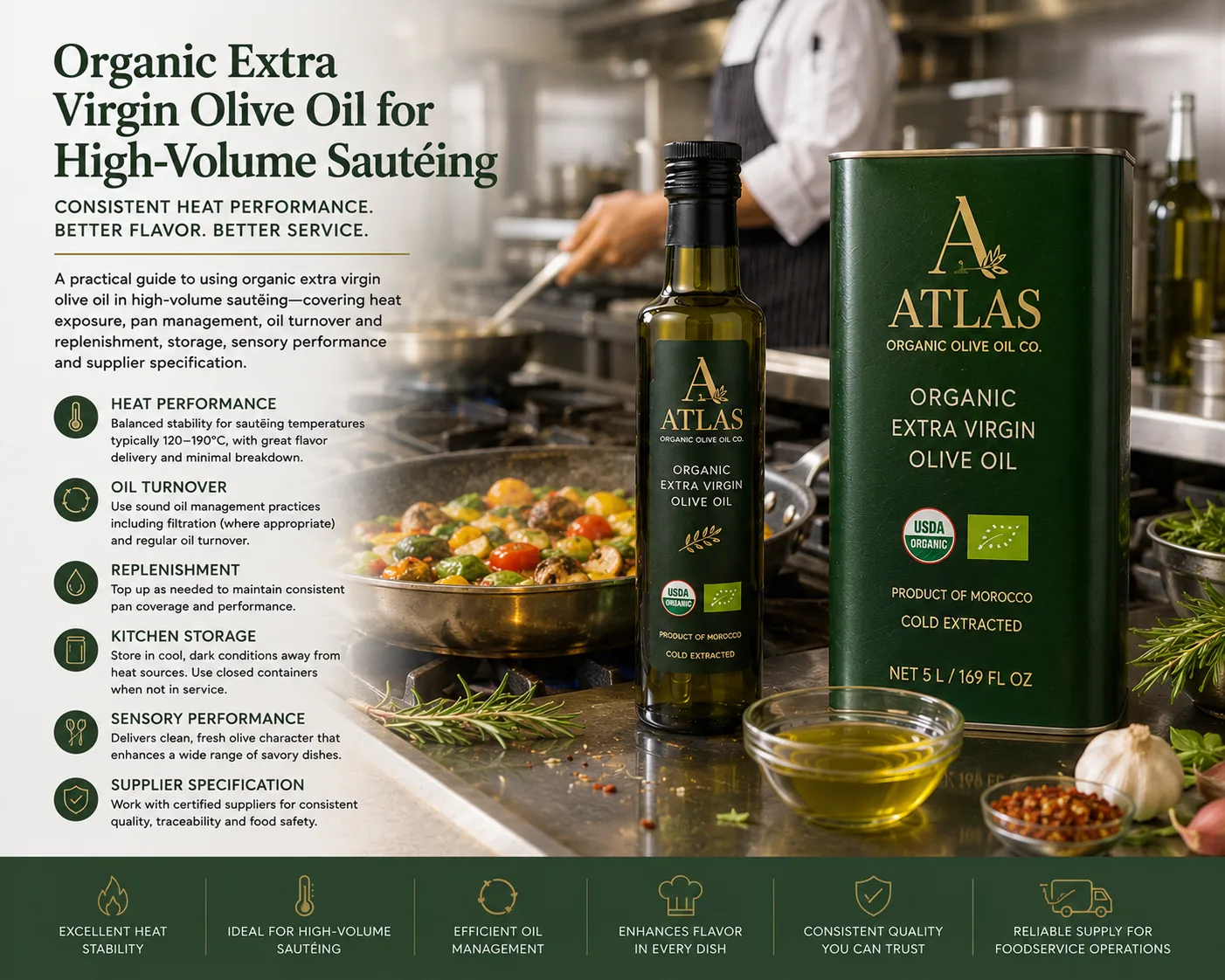
High-volume sautéing requires a practical balance of flavor, heat exposure, turnover, equipment design and cost. Kitchen teams need repeatable operating controls rather than mythology around a single smoke-point number.
Foodservice quality depends heavily on operating discipline. Pack turnover, storage location, time beside the range, pan temperature, food load and staff practices can matter as much as the starting oil. The practical objective is not to find an abstract “best” oil; it is to define an oil and kitchen-handling system that remain appropriate for the intended menu, service volume and sensory target.
High-volume sautéing can also mean very different things from one operation to another. A restaurant preparing vegetables to order, a hotel kitchen running multiple sauté stations and a commissary producing large batches may expose the oil to different temperatures, residence times and replenishment patterns. Supplier selection should therefore begin with the actual operating model.
1. Start with the decision framework
Before requesting samples, define the commercial and operational job the oil must perform. The brief should state the menu applications, expected daily usage, trial and annual volumes, pan or equipment type, typical heat exposure, sensory role, pack format, storage location and required organic documentation.
- Define the actual pan-temperature range and replenishment practice used by the kitchen.
- Identify whether the oil is primarily used for sautéing, pan finishing, sauce preparation or several tasks.
- Use containers sized for rapid turnover and keep reserve stock away from direct heat and light.
- Train teams to recognize sensory deterioration, contamination and poor handling rather than repeatedly topping up oil without a clear operating rule.
Menu compatibility should be part of the same discussion. A restrained oil may be appropriate where the kitchen wants the ingredients and seasonings to dominate, while a more expressive extra virgin olive oil can contribute useful character to vegetables, seafood, grains or Mediterranean-style preparations.
A useful specification separates the applicable category baseline from tighter internal purchasing targets. It should also distinguish between values guaranteed at release, agreed commercial targets, typical characteristics and reference information associated with a particular harvest or origin.
2. Practical workflow
Move from sample evaluation to operational approval in controlled stages. First, screen candidate oils for category quality and menu compatibility. Second, test them during actual sauté service. Third, review storage, decanting and replenishment practices. Finally, define receiving and change-control rules so future lots are handled consistently.
- Write a one-page brief. Include menu applications, organic status, olive-oil category, sensory profile, expected daily use, pack size, annual volume, destination and timing.
- Pre-screen supplier documentation. Confirm organic certification, lot traceability, available foodservice pack formats and the ability to provide agreed analytical documentation.
- Sample in context. Taste candidate oils neat for defects and overall style, then evaluate them with the actual ingredients and cooking methods used on the menu.
- Observe real heat exposure. Record normal pan temperatures, typical heating time, food load and whether empty pans are allowed to remain hot with oil in them.
- Check kitchen handling. Review where open containers are kept, how oil is decanted, how often bottles or cans are replenished and how quickly opened packs are consumed.
- Pilot during representative service. Evaluate the oil during actual high-volume production rather than only during a quiet bench or tasting exercise.
- Evaluate sensory performance. Compare aroma, flavor and any signs of deterioration at the start and end of representative service periods.
- Define release and change control. Decide who approves a new harvest, new oil lot, new pack format or material change to the foodservice specification.
3. Manage temperature as an operating variable
A single quoted smoke-point value does not describe the full sautéing system. Actual oil performance depends on the condition of the incoming oil, the pan, burner or induction setting, heating duration, food load, moisture, repeated exposure and the practices of the kitchen team.
In practical sautéing, the pan should be operated for the food being cooked rather than heated unnecessarily while empty. Allowing small quantities of oil to remain in an unattended hot pan can create harsher exposure than adding oil immediately before ingredients enter the pan.
Different menu items may also require different heat profiles. Delicate vegetables, seafood, proteins and sauce bases do not necessarily need the same pan temperature, so kitchen testing should represent the real menu rather than one generalized high-heat demonstration.
The goal is repeatability: staff should understand the cooking range that produces the required result without subjecting the oil to unnecessary time at elevated temperature.
4. Size packs around real kitchen turnover
Pack size is an operational quality decision as well as a purchasing decision. A large container can offer attractive unit economics, but those savings are less meaningful if an opened pack remains beside a hot line for an extended period.
For fast-moving kitchens, larger foodservice formats may be practical because the oil is consumed quickly. Lower-volume locations may benefit from smaller containers that reduce the time between opening and complete use.
Reserve inventory should be stored away from the cooking line in a suitable storage area protected from unnecessary heat and direct light. Only the working quantity needed for service should be kept close to production equipment.
Where oil is transferred into squeeze bottles, pitchers or other working containers, the kitchen should use clean, food-contact equipment and a routine that avoids repeatedly adding fresh oil on top of old residues without cleaning.
5. Define replenishment and discard practices
High-volume sautéing differs from a dedicated deep-frying operation, but kitchens may still create repeated-use patterns if oil remains in pans, holding vessels or equipment between batches. Those practices should be defined rather than left to individual habit.
Staff should know when oil is intended for one cooking cycle, when limited replenishment is acceptable and when used oil should be discarded. The rule should reflect the menu, equipment and food-safety procedures of the operation.
Sensory deterioration is also useful operational information. Unusual stale, burnt, contaminated or strongly degraded aromas should trigger corrective action rather than being masked through continual addition of fresh oil.
Cross-contact with crumbs, spices, proteins or other food residues can also change the oil's behavior and flavor. Replenishment procedures should therefore account for contamination from the actual cooking process.
6. Quality controls that belong in the conversation
Extra virgin olive oil is defined through more than free acidity. Buyers should use the current applicable category standard, appropriate laboratory methods and, where required, organoleptic assessment. Foodservice programs can then add internal sensory criteria that reflect the actual menu and brand style.
- Size packs around realistic daily and weekly use rates.
- Keep reserve stock away from direct light and kitchen heat.
- Write practical opening, decanting, sautéing, replenishment and discard procedures.
- Train teams to recognize significant sensory deterioration or contamination.
- Evaluate new oil lots against representative menu items, not only in neat tasting.
Lot-to-lot sensory consistency can matter when the oil contributes directly to the finished flavor. Agricultural variation is normal, but the purchasing program can define an acceptable range for fruitiness, bitterness and pungency so a new harvest does not unexpectedly alter established recipes.
7. Protect oil before it reaches the pan
Oil quality can be compromised before cooking begins if working containers are stored beside ovens, ranges, heat lamps or sunny windows. Daily kitchen layout should therefore be considered part of the ingredient-control system.
Opened containers should be closed when practical and should not remain unnecessarily exposed to air. If the operation decants oil into smaller working bottles, the cleaning, refilling and rotation procedure should be standardized.
Stock rotation is equally important. Receiving teams should be able to identify lot information and follow an orderly first-in, first-out or other approved stock rotation system appropriate to the operation.
The goal is straightforward: maintain the supplier's incoming quality for as long as reasonably possible before the oil enters a hot pan.
8. Match oil intensity to the menu
Stronger is not automatically better in high-volume sautéing. A highly expressive oil may work beautifully with some vegetables, grains, legumes or Mediterranean preparations but may compete with more delicate sauces or seafood dishes.
Heat can reduce some fresh aromatic notes, while bitterness and pungency may remain noticeable to different degrees depending on the dish. Candidate oils should therefore be evaluated after cooking, not only from a tasting glass.
For operations with broad menus, the sourcing team may prefer a versatile sensory profile that can support multiple applications. A more specialized program may justify a stronger or more distinctive profile when olive oil is central to the menu identity.
9. Evaluate cost through use, not only purchase price
Foodservice oil economics are influenced by more than price per liter. Pack size, waste, over-dosing, poor storage, slow turnover and inconsistent staff practices can all change the real cost per finished dish.
Controlled dosing can improve consistency as well as cost visibility. If different cooks routinely use very different oil quantities for the same menu item, the operation may see unnecessary variation in flavor, calorie contribution and food cost.
Trial comparisons should therefore consider how an oil performs in service, how much is typically used per portion and whether the chosen pack format supports efficient turnover without creating avoidable waste.
10. Common failure modes
Most problems are not caused by a lack of descriptive language on the specification. They usually result from missing operational controls or from treating a single technical number as a complete quality story.
- Keeping opened oil beside a hot range for prolonged periods.
- Leaving small amounts of oil in empty pans under high heat.
- Using the same oil repeatedly without a clear replenishment or discard policy.
- Choosing pack sizes that remain open far longer than actual turnover supports.
- Refilling working bottles indefinitely without proper cleaning and rotation.
- Choosing oil intensity without testing the actual menu.
- Training staff around a single smoke-point number instead of practical cooking controls.
- Changing harvest or sensory profile without a defined reapproval process.
Corrective-action triggers should be built around objective evidence: out-of-specification results, unexpected sensory defects, contaminated working containers, damaged seals, broken traceability, temperature abuse or documented operating deviations.
The program should also define what happens after a deviation is identified. Depending on the issue, incoming stock may be placed on hold, working containers may be discarded and replaced, or the supplier lot may be investigated using retained samples and documentation.
11. What to put in the purchase specification
A useful purchasing specification should connect incoming olive-oil requirements directly to the realities of high-volume foodservice. It should be detailed enough to prevent ambiguity while remaining practical for procurement, culinary, receiving and quality teams.
12. Validate the oil during real service
Supplier approval establishes whether the incoming olive oil meets the purchasing specification. It does not guarantee that the kitchen's handling and sautéing practices will preserve the desired sensory performance throughout service.
Operational validation should use actual menu items, pans, burners or induction equipment, typical batch sizes, normal service pace, working containers and replenishment practices.
Multi-unit operators should also consider whether procedures remain practical across different locations. A sourcing program is most useful when pack size, storage guidance and kitchen controls can be implemented consistently by the people who actually use the oil.
13. Questions to ask a potential olive-oil supplier
Supplier discussions should cover both oil quality and the practical ability to support a repeatable foodservice program. Sensory consistency, pack formats, documentation and delivery reliability can all matter to high-volume kitchens.
- Which organic certification and shipment documents accompany each lot?
- Which analytical parameters are reported on the commercial certificate of analysis?
- How is lot traceability maintained through storage, packing and shipment?
- Which sensory profiles can be supplied consistently from harvest to harvest?
- Which foodservice pack sizes are available for different rates of kitchen turnover?
- Can candidate oils be screened against representative sautéed menu applications?
- How are harvest, origin, processing or specification changes communicated?
- What lead times and minimum quantities apply to the required format?
The objective is a repeatable sourcing program rather than a one-time sample approval. Clear specifications, traceable lots, appropriate pack formats and agreed change-control procedures allow buyer and supplier to work from the same commercial definition of acceptable oil.
Next step
Turn this guide into a sourcing brief by listing your menu applications, expected daily and annual volume, kitchen format, preferred pack size, destination, sensory target, trial requirement, target launch date and required organic or quality documentation.
Atlas can then compare suitable organic extra virgin olive-oil programs on the same commercial basis, coordinate kitchen trials and help align sensory style, pack format, documentation and supply planning with the requirements of your high-volume sautéing program.