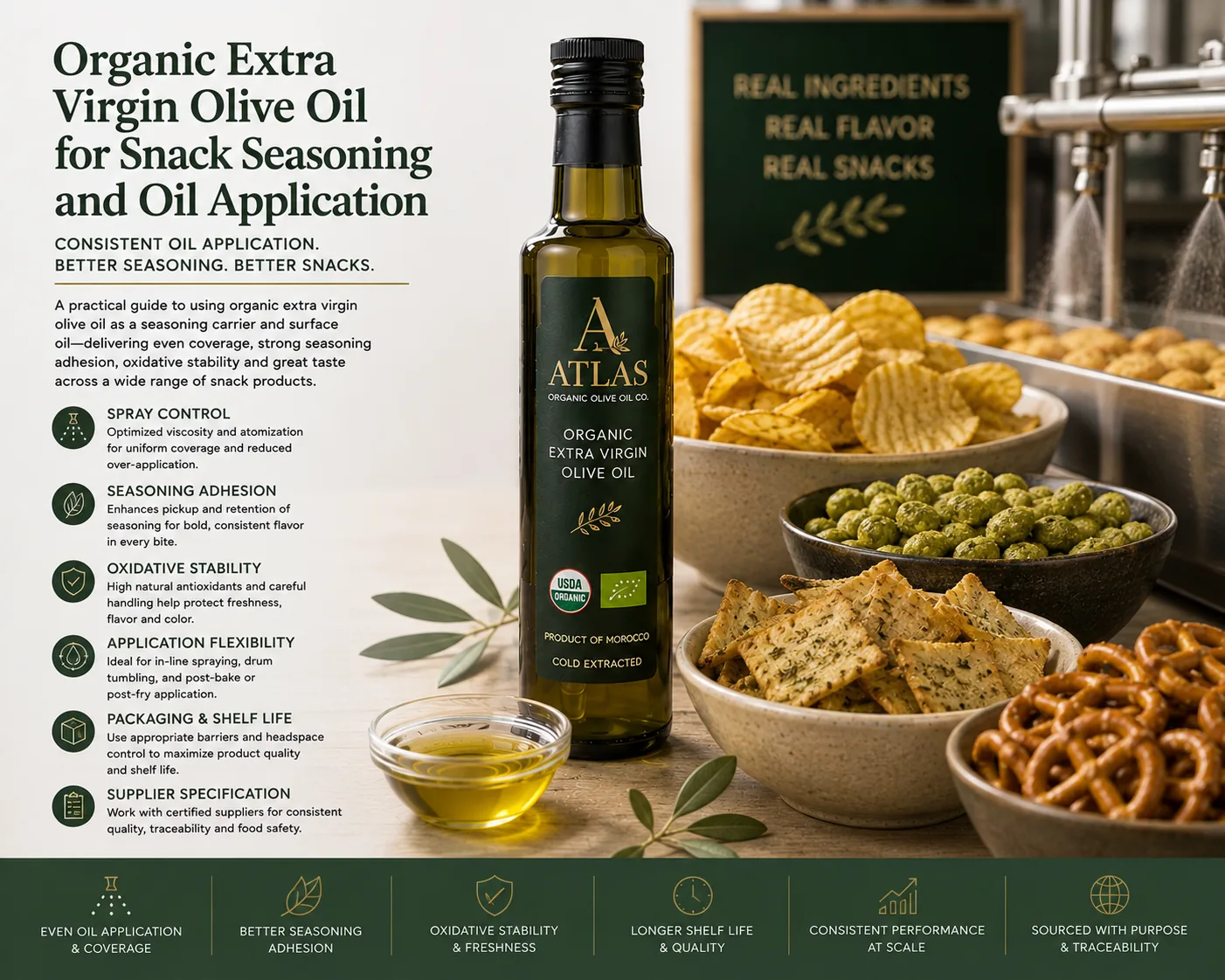
Snack applications use oil as a seasoning carrier and adhesion aid, often across a large exposed surface area. Application uniformity, oxidative shelf life and compatibility with the seasoning system can therefore matter as much as the oil's flavor when sampled on its own.
Snack surfaces create substantial lipid exposure to oxygen. Uniform application, equipment residence time, spray conditions and high-barrier packaging are central controls. The practical objective is not to find an abstract “best” oil; it is to define the oil, application system and package that remain fit for the intended snack, production line, channel and shelf life.
The exact requirement depends on the substrate. Chips, crackers, extruded snacks, roasted pulses, nuts and other products can differ in surface roughness, porosity, temperature at oil application and seasoning pickup. Those differences can change both the amount of oil required and the way the final flavor is perceived.
1. Start with the decision framework
Before requesting samples, define the commercial and technical job the oil must perform. The brief should state the snack substrate, target market, trial and annual volumes, target oil pickup, seasoning system, application method, line speed, expected package format, sensory role, storage conditions and required organic documentation.
- Control spray temperature, droplet size and application rate for consistent pickup.
- Measure oil exposure to heat and air in holding, pumping and recirculating seasoning systems.
- Evaluate the oil with the actual seasoning blend rather than relying only on neat tasting.
- Select packaging barrier and gas-flush strategy from real finished-product shelf-life data.
If olive oil is named prominently on the front of pack or is intended to contribute a recognizable premium flavor, the sensory target deserves additional attention. In a strongly seasoned snack the oil may be mainly a supporting carrier, while in a lightly salted product its fruitiness or pungency may be more noticeable.
A useful specification separates the applicable category baseline from tighter internal purchasing targets. It should also clarify which values are guaranteed at release, which are agreed commercial targets, which are typical characteristics and which are reference information linked to a particular harvest or origin.
2. Practical workflow
Move from sample evaluation to commercial approval in controlled stages. First, screen candidate oils for category quality and sensory fit. Second, test application behavior on the intended snack substrate. Third, confirm full seasoning pickup, packaging and shelf-life performance under production-equivalent conditions. Finally, define routine release criteria for future lots.
- Write a one-page brief. Include snack type, organic status, olive-oil category, target pickup, sensory profile, application method, pack, volume, destination and timing.
- Pre-screen supplier documentation. Confirm organic certification, lot traceability, commercial pack formats and the ability to provide agreed analytical information for shipped lots.
- Sample in context. Taste candidate oils neat for defects and style, then apply them to the actual snack with the intended seasoning system.
- Measure application performance. Record oil pickup, distribution uniformity, spray temperature, pressure or flow conditions and any relevant equipment settings.
- Check seasoning adhesion. Confirm that the oil level supports the required powder or particulate pickup without creating excessive greasiness or uneven flavor distribution.
- Pilot the commercial system. Use production-equivalent pumps, spray nozzles, drums, seasoning equipment, line speed, hold times and packaging conditions.
- Evaluate packaged shelf life. Review aroma, flavor, crispness and oxidative change in the actual package over the intended commercial storage period.
- Define release and change control. Decide who approves a new harvest, new oil lot, new spray setup, new seasoning formulation or material packaging change.
3. Control oil application, not just average usage
Average oil usage per batch is useful, but it does not show whether every piece of product receives similar coverage. A snack line can achieve the correct total oil consumption while still producing areas of over- and under-application.
Spray pattern, nozzle condition, product bed depth, tumble action, line speed and substrate temperature can all affect distribution. For that reason, application trials should evaluate uniformity as well as total pickup.
Droplet size can also influence coverage. A very coarse application may create localized wet spots, while an overly fine spray may behave differently depending on equipment geometry and airflow. The appropriate setup should be established with the actual production system rather than from theoretical targets alone.
Application rate should be controlled by a repeatable measurement method. Whether the plant uses mass balance, flow measurement, batch weighing or another approach, the same method should be used consistently during trials and routine production.
4. Design oil and seasoning as one system
In many snacks, oil is the bridge between the substrate and the seasoning blend. Its application level can affect powder adhesion, flavor release, dusting losses and mouthfeel. The correct rate is therefore a formulation decision as well as an ingredient-cost decision.
Seasoning composition matters. Fine powders, larger particulates, salt, cheese-style seasonings, herbs, spices and acidic flavor systems may not behave identically on the same oiled substrate. Trials should use the complete commercial seasoning blend.
The timing between oil and seasoning application can also influence pickup. Production teams should standardize the sequence and minimize uncontrolled delay where it materially affects adhesion or distribution.
Sensory balance should be judged after the complete application step. A mild oil may allow complex seasonings to dominate, while a more aromatic extra virgin olive oil may contribute positively to simpler salt, herb or Mediterranean-style profiles.
5. Quality controls that belong in the conversation
Extra virgin olive oil is defined through more than free acidity. Buyers should use the current applicable category standard, appropriate laboratory methods and, where required, organoleptic assessment. Commercial snack programs can then add internal criteria describing the sensory profile and consistency needed by the finished product.
- Control oil application rate and temperature.
- Check distribution uniformity, not only average usage.
- Avoid unnecessarily long warm recirculation in seasoning systems.
- Evaluate the oil together with the finished seasoning system.
- Use finished-pack shelf-life data to choose barrier and gas-flush conditions.
Lot-to-lot sensory consistency can be especially important in lightly seasoned products. Agricultural variation is normal, but the purchasing specification can define an acceptable range for fruitiness, bitterness and pungency so a new harvest does not create an unexpected flavor shift.
6. Manage residence time, heat and recirculation
Oil can spend meaningful time in day tanks, hoses, pumps, heated lines and recirculating seasoning equipment before reaching the snack. That exposure should be considered part of the application process rather than an invisible utility step.
Prolonged warm residence combined with repeated oxygen contact can work against incoming oil quality. Equipment should therefore be operated with practical limits for hold time and temperature based on the plant's process and validation work.
At production breaks or shutdowns, the handling procedure should define what happens to residual oil in the system. Repeatedly carrying warm oil forward without a defined rule can create inconsistent age and exposure from one production period to another.
Cleaning and changeover procedures should also avoid unnecessary contamination or mixing between oil lots where lot identity matters for traceability and release.
7. Account for the snack's high exposed surface area
Snack products often spread a relatively thin oil layer across a large surface. That geometry creates a different oxidative environment from oil stored in a sealed bulk container, because much more of the lipid phase can be exposed to package oxygen.
Substrate characteristics can increase complexity. Porous or highly textured snacks may distribute oil across internal and external surfaces, while seasonings and other ingredients may influence the overall shelf-life behavior of the finished product.
Incoming oil quality therefore matters, but it cannot replace finished-product shelf-life testing. The real question is how the complete snack system behaves after application, packaging, distribution and storage.
8. Match packaging protection to the real shelf-life target
Packaging is a central part of the oil system in shelf-stable snacks. Oxygen transmission, residual package oxygen, seal integrity and storage temperature can all influence flavor stability over time.
Where nitrogen flushing or another gas-management approach is used, the relevant operating conditions should be tied to finished-product validation rather than treated as a generic guarantee. Package performance depends on the complete combination of film structure, filling operation, sealing and distribution.
High-barrier material can be valuable, but barrier performance should be selected against the intended shelf life and actual product sensitivity. More barrier is not a substitute for good oil handling, and good oil handling is not a substitute for an appropriate package.
Shelf-life trials should assess the finished snack in its commercial package and include sensory evaluation for stale, cardboard-like or rancid notes alongside other relevant quality attributes such as crispness and seasoning character.
9. Common failure modes
Most problems are not caused by a lack of descriptive language on the specification. They usually come from missing process controls or from treating one incoming measurement as a complete predictor of finished-product performance.
- Recirculating oil too long in warm equipment.
- Using average application rate without checking distribution uniformity.
- Underestimating oxidation risk created by high snack surface area.
- Selecting an oil from neat tasting without evaluating the seasoning system.
- Allowing nozzle condition or spray settings to drift without verification.
- Choosing packaging barrier without finished-product shelf-life data.
- Holding opened bulk oil longer than the plant's realistic turnover supports.
- Changing harvest or sensory profile without a defined reapproval procedure.
Corrective-action triggers should be based on objective evidence: out-of-specification analytical results, sensory defects, abnormal oil pickup, application non-uniformity, excessive hold time, damaged seals, broken traceability, temperature excursions or packaging failures.
The program should also define what happens after a deviation is identified. Depending on the issue, an incoming oil lot, seasoning run or finished-product lot may be placed on hold, investigated, compared with retained samples or subjected to additional approved evaluation before release.
10. What to put in the purchase specification
A practical purchasing specification should connect incoming olive-oil requirements directly to the snack application. It should be detailed enough to prevent ambiguity while remaining usable by procurement, quality, product development and operations.
11. Validate the finished snack system
Supplier approval establishes whether the incoming olive oil meets the purchasing specification. It does not guarantee uniform seasoning pickup, finished flavor or shelf-life performance in the packaged snack.
Finished-product validation should use the actual snack substrate, oil application rate, spray settings, seasoning blend, process temperatures, equipment residence times, package structure, gas-flush conditions and intended storage environment.
Scale-up can reveal issues that bench testing cannot. Production pumps, nozzles, seasoning drums, line speeds and product-bed depths can all alter application behavior. Commercial-equivalent trials are therefore important before a new oil or application setup is released into routine production.
12. Questions to ask a potential olive-oil supplier
Supplier discussions should cover both ingredient quality and the ability to support a repeatable snack program. Sensory consistency, documentation, packaging options and commercial lead time can all affect operational performance.
- Which organic certification and shipment documents accompany each lot?
- Which analytical parameters are reported on the commercial certificate of analysis?
- How is lot traceability maintained through storage, transfer, packing and shipment?
- Which sensory profiles can be supplied consistently from harvest to harvest?
- Can candidate oils be screened against a defined snack seasoning target?
- What bulk and packaged formats are available for trials and routine production?
- How are harvest, origin, processing or specification changes communicated?
- What lead times and minimum quantities apply to the required format?
The objective is a repeatable sourcing program rather than a one-time sample approval. Clear specifications, traceable lots, retained samples and agreed change-control procedures allow buyer and supplier to work from the same definition of acceptable oil.
Next step
Turn this guide into a sourcing brief by listing your snack substrate, target oil pickup, seasoning system, application method, annual volume, trial requirement, destination, desired pack format, sensory target, target launch date and required organic or quality documentation.
Atlas can then compare suitable organic extra virgin olive-oil programs on the same commercial basis, coordinate samples for line or pilot trials and help align sensory style, packaging, documentation and supply planning with the requirements of your snack seasoning program.