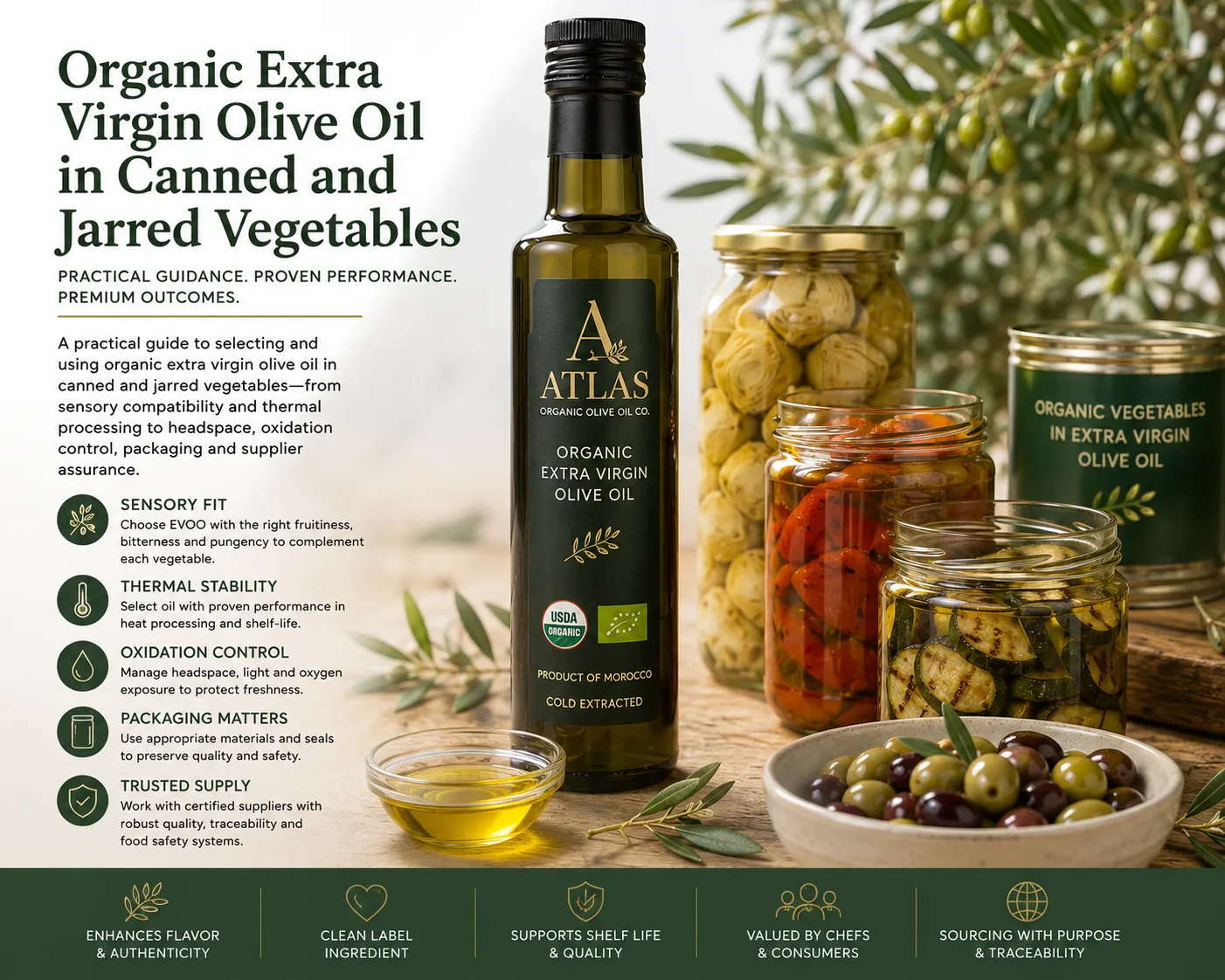
For canned or jarred vegetables packed in oil, the oil becomes part of the consumer's visual and sensory experience. Thermal treatment, residual moisture, headspace, herbs, spices and contact with plant solids can change its flavor, appearance and oxidative behavior over time.
Prepared vegetable products add process complexity. Thermal treatment, water activity, acidification where applicable, particulates, chilled or ambient storage and packaging all affect how olive oil performs. The practical objective is not to find an abstract “best” oil; it is to define the oil specification and handling system that remain fit for the intended vegetable product, processing route, channel and validated shelf life.
The oil may serve several roles at once. It can act as a cover medium, contribute directly to the recipe, carry herbs or spices, influence mouthfeel and become part of the product's premium presentation. Those roles should be defined early, because an oil selected primarily for flavor may require a different sensory profile from one intended mainly to provide a clean, neutral background.
1. Start with the decision framework
Before requesting samples, define the commercial and technical job the oil must perform. The brief should state the vegetable type, finished-product style, target market, annual and trial volumes, expected oil-to-solid relationship, package format, sensory role, process exposure, storage conditions and required organic documentation.
- Define whether the oil is a cover medium, a recipe ingredient or both.
- Evaluate the oil after the complete thermal process and again during the intended storage period.
- Consider how herbs, garlic, peppers, spices or other ingredients may alter the final sensory balance.
- Treat acidification, scheduled process requirements and pathogen controls as separate mandatory food-safety work rather than functions of the olive oil.
The vegetable itself should be part of the specification discussion. Artichokes, peppers, tomatoes, mushrooms, eggplant, olives and mixed vegetables can differ substantially in moisture, flavor intensity, texture and processing requirements. A sensory profile that works well in one product may be too dominant or too mild in another.
A useful specification separates the applicable legal or category baseline from tighter internal targets. It should also clarify which values are guaranteed at release, which are agreed commercial targets, which are typical characteristics and which are only reference information linked to a particular origin, harvest or production lot.
2. Practical workflow
Move from sample evaluation to commercial approval in controlled steps. First, screen suppliers and candidate oils against the intended application. Second, test the oil in the actual vegetable preparation. Third, reproduce commercial filling and processing conditions. Finally, establish receiving, release and change-control procedures for routine production.
- Write a one-page brief. Include vegetable type, product style, organic status, olive-oil category, filtration preference if relevant, sensory profile, pack, volume, destination and timing.
- Pre-screen supplier documentation. Confirm organic certification, lot traceability, commercial packaging options and the ability to provide agreed analytical documentation before extensive formulation work begins.
- Sample in context. Taste the oil neat for obvious defects and style, then evaluate it with the intended vegetables, herbs, seasonings and other recipe components.
- Review documents. Confirm lot identity, analytical results, organic status, traceability and any import, food-contact or destination-specific records required by the program.
- Pilot the complete system. Use commercial-equivalent preparation, oil dosing, filling, headspace control, sealing, thermal treatment, cooling and storage conditions rather than relying only on bench samples.
- Evaluate after processing. Thermal treatment and prolonged contact with vegetables can alter the perceived fruitiness, bitterness and pungency of the oil.
- Validate shelf life. Assess the complete product and package over the intended commercial life using appropriate sensory, physical, chemical and packaging criteria.
- Define release and change control. Decide who approves a new harvest, new oil lot, new vegetable supplier, new package component or material specification change.
3. Quality controls that belong in the conversation
Extra virgin olive oil is defined through more than free acidity. Buyers should use the current applicable category standard, appropriate laboratory methods and, where required, organoleptic assessment. Commercial programs can then add internal criteria that describe the sensory style actually needed for the vegetable application.
Sensory style should be selected in the finished food context. Delicate vegetables may benefit from a softer oil profile that does not dominate the recipe, while roasted peppers, artichokes, tomatoes or strongly seasoned vegetables may support more pronounced fruitiness, bitterness or pungency. Neither style is universally better; the commercial target should match the finished eating experience.
- Map every meaningful heat and oxygen exposure step.
- Validate food safety independently from olive-oil quality.
- Set incoming oil criteria and finished-product sensory criteria separately.
- Define lot traceability and retained-sample expectations.
- Review oil performance together with the intended vegetable matrix and package.
Lot-to-lot consistency also matters. Agricultural ingredients naturally vary, so the realistic objective is controlled variation within an agreed specification. Retained samples, written sensory targets and clearly defined approval criteria can help buyers compare future harvests more consistently.
4. Manage oxygen, moisture and storage exposure
The stability of vegetables packed in oil is influenced by more than incoming oil quality. Residual moisture, plant solids, seasonings, oxygen exposure, process conditions and storage environment can all affect the complete system. This is why finished-product performance should be evaluated separately from the incoming certificate of analysis.
During production, unnecessary oxygen exposure can occur through repeated transfer, turbulent handling or extended storage in partly empty bulk containers. Matching bulk-pack size to actual plant turnover can therefore be just as important as specifying the incoming oil itself.
The finished package adds another set of variables. Headspace, closure integrity, container geometry and light exposure can influence quality over time. Transparent glass jars may provide strong visual merchandising value, but products displayed in bright retail environments should be evaluated with their real light exposure in mind.
Moisture distribution within the product also matters because the oil phase and aqueous components do not behave as one uniform system. Vegetable preparation, draining, brining, acidification and other process steps should therefore be controlled according to the finished product's validated formulation and process.
5. Evaluate thermal processing and filling together
Canned and jarred vegetables may use different processing approaches depending on formulation, acidity, package and intended storage conditions. Food-safety controls must be established and validated independently by the appropriate technical or process authority; the presence of extra virgin olive oil does not make a product shelf-stable by itself.
From a quality perspective, however, filling and thermal processing still influence the oil. Heating can soften some fresh olive-oil aromas, while prolonged contact with vegetables and seasonings may change the flavor balance during storage. Commercial-equivalent processing trials are therefore more informative than neat oil tasting alone.
Fill weight and headspace should also be consistent. Too little cover medium may affect appearance and consumer experience, while excessive oil can change both economics and formulation balance. The commercial standard should define how oil addition is controlled and measured for the selected package size.
6. Common failure modes
Most problems are not caused by a lack of descriptive language on the specification. They usually come from missing operational controls or from treating one incoming measurement as a complete predictor of finished-product performance.
- Assuming extra-virgin status makes a shelf-stable vegetable product safe.
- Specifying sensory targets only before retort, pasteurization or other processing.
- Ignoring interaction between residual water, vegetable solids and oil stability.
- Choosing an oil on neat tasting without testing it with the actual vegetable recipe.
- Using inconsistent oil fill levels or excessive package headspace.
- Leaving bulk oil exposed to heat, light or oxygen longer than necessary.
- Changing harvest or sensory profile without a defined reapproval process.
- Assuming incoming oil quality guarantees finished-product shelf life.
Corrective-action triggers should be based on objective evidence: out-of-specification analytical results, unexpected sensory defects, damaged seals, broken traceability, temperature excursions, package leakage, closure problems or documented process deviations.
The program should also define what happens after a deviation is identified. Depending on the issue, a lot may be placed on hold, investigated, subjected to approved additional testing or rejected. Clear responsibilities between quality, procurement, production and the supplier make these decisions more consistent.
7. What to put in the purchase specification
A strong purchasing specification should connect incoming olive-oil requirements with the actual vegetable application. It should be detailed enough to prevent ambiguity while remaining practical for procurement, quality, operations and receiving teams.
8. Validate the complete finished product
Supplier approval establishes whether the incoming olive oil meets the agreed purchasing requirements. It does not establish the safety, sensory stability or commercial shelf life of the finished canned or jarred vegetable product.
Finished-product validation should account for the actual vegetables, residual moisture, seasonings, oil quantity, package format, closure, thermal process, distribution route and storage conditions. The appropriate testing program should be defined by the manufacturer's technical and quality teams for the specific product.
Scale-up deserves particular attention. Production equipment may introduce longer holding periods, different transfer conditions, larger bulk containers and different heating or cooling profiles from laboratory trials. Candidate oils should therefore be confirmed under commercial-equivalent conditions before routine use.
9. Questions to ask a potential olive-oil supplier
Supplier discussions should cover both ingredient quality and the practical ability to support a repeatable prepared-food program. A technically suitable oil is most useful when documentation, packaging, traceability and delivery are equally dependable.
- Which organic certification and shipment documents accompany each lot?
- Which analytical parameters are reported on the commercial certificate of analysis?
- How is lot traceability maintained through storage, transfer, packing and shipment?
- Which sensory profiles can be supplied consistently from harvest to harvest?
- What bulk and packaged formats are available for trials and routine production?
- How are origin, harvest, process or specification changes communicated?
- What lead times and minimum quantities apply to the selected format?
- Can retained or pre-shipment samples be incorporated into the buyer's approval program?
The objective is a repeatable sourcing program rather than a one-time sample approval. Clear specifications, traceable lots, reference samples and defined communication procedures allow buyer and supplier to work from the same definition of acceptable product.
Next step
Turn this guide into a sourcing brief by listing your vegetable application, product style, annual volume, trial requirement, destination, desired oil format, target sensory profile, target launch date and required organic or quality documentation.
Atlas can then compare suitable organic extra virgin olive-oil programs on the same commercial basis, coordinate samples for application trials and help align sensory style, packaging, documentation and supply planning with the requirements of your canned or jarred vegetable program.