Foods intended for infants or young children require especially disciplined formulation, contaminant control, nutrition design, supplier qualification and label review. Organic extra virgin olive oil may be used as a fat ingredient when it fits the nutritional, sensory, processing and regulatory requirements of the finished product, but it should never be marketed as a medical intervention.
Products for vulnerable or highly regulated populations require conservative claims, age-appropriate nutrition and stronger supplier-control expectations. The practical objective is not to identify an abstract “best” oil. It is to define an oil specification, supply program and handling system that remain appropriate for the intended food, manufacturing process, destination market, distribution channel and validated shelf life.
That distinction matters because the ingredient does not operate in isolation. Its sensory character may interact with vegetables, cereals, pulses, proteins or fruit ingredients; its oxidative stability can be affected by processing and package headspace; and its commercial suitability depends on consistent documentation, lot control and repeatable handling from supplier to production line.
1. Start with the decision framework
Before requesting samples, write down the commercial and technical job the oil must perform. The brief should state the finished product application, intended consumer group, target market, annual and trial volumes, expected pack format, sensory role, process exposure, expected storage conditions and required organic documentation. If olive oil will be highlighted prominently on the finished label, the sensory and origin brief deserves even closer attention because consumers may perceive its flavor as part of the product's identity.
- Use a qualified nutrition and regulatory team to set fat inclusion, nutrient targets and age-appropriate formulation requirements for the specific product and destination market.
- Define contaminant, pesticide, authenticity, foreign-material and microbiological supplier requirements appropriate to the finished-food category and risk assessment.
- Decide whether the oil is intended mainly to contribute fat, flavor, organic positioning, ingredient declaration value or a combination of those functions.
- Keep consumer claims conservative and supported; do not infer developmental, preventive or therapeutic benefits from olive oil alone.
A useful specification separates the applicable legal or category baseline from tighter internal purchasing targets. It also makes clear which values are guaranteed at release, which are agreed commercial targets, which are typical characteristics and which are reference data associated with a particular origin, cultivar, harvest period or production lot.
For multi-market products, the formulation team should also identify requirements that vary by destination before commercial approval. Ingredient naming, organic labeling, nutrition declarations, contaminant limits, documentation and age-category conventions may not be identical across markets, so a specification written for one destination should not automatically be assumed suitable for another.
2. Practical workflow
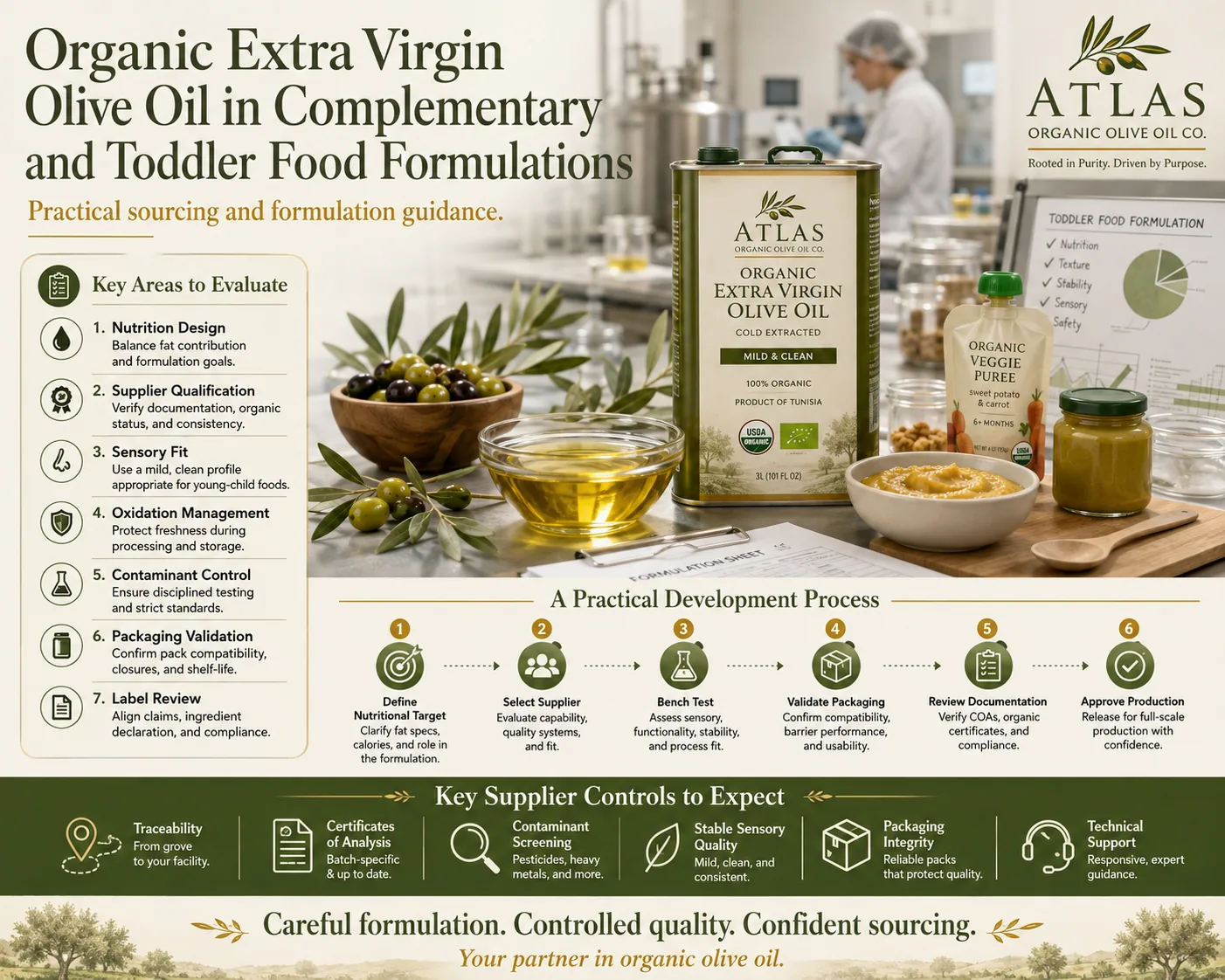
Move from bench evaluation to commercial approval in controlled steps. First, screen candidate lots against the intended application. Second, test the oil in the real formulation and manufacturing process. Third, confirm that the selected packaging, storage conditions and distribution route protect the ingredient. Finally, define receiving and change-control procedures so future lots are evaluated consistently.
- Write a one-page brief. Include category, organic status, intended food, destination, sensory profile, filtration or harvest preference if relevant, pack, estimated volume and timing.
- Pre-screen supplier documentation. Confirm that the supplier can support the required organic certification, traceability model, lot-level analytical documentation and commercial pack format before extensive formulation work begins.
- Sample in context. Evaluate the oil neat for obvious sensory defects and overall style, then test it in the actual food matrix. A flavor characteristic that seems prominent in neat oil may be much less noticeable after blending, cooking or homogenization.
- Review analytical and traceability records. Confirm lot identity, agreed analytical results, organic status, certificate linkage and any import, food-contact or market-specific records required by the purchasing specification.
- Pilot the complete system. Use commercial-equivalent mixing, heating, transfer, holding, filling and storage conditions rather than relying only on laboratory handling.
- Evaluate the finished product over time. Review sensory quality, physical stability, package performance and other relevant product characteristics through the planned shelf-life study.
- Define release and change control. Decide who approves a new harvest, new lot, origin change, packaging component, specification revision or other material change before it reaches routine production.
3. Quality controls that belong in the conversation
Extra virgin olive oil is defined through more than a single analytical value such as free acidity. Buyers should work from the current applicable category standard, use appropriate laboratory methods and include organoleptic assessment where the relevant standard or purchasing program calls for it. For commercial programs, internal criteria should also describe the sensory style that the finished formulation actually needs.
A buyer may, for example, prefer a relatively delicate profile when the oil is being incorporated into a mild vegetable, cereal or fruit-based formulation. A more assertive oil may be suitable in other foods, but the choice should come from application testing rather than from assuming that stronger bitterness, pungency or fruitiness is inherently better for every product.
- Use qualified regulatory, food-safety and nutrition specialists.
- Set contaminant and authenticity requirements explicitly rather than leaving them implied.
- Define the analytical methods and lot-document expectations in the purchasing specification.
- Establish an acceptable sensory range that reflects the actual finished-food application.
- Keep marketing claims separate from ingredient quality and purchasing specifications.
Incoming approval should also account for lot-to-lot consistency. Agricultural ingredients naturally vary, so the practical goal is not perfect sameness but controlled variation within an agreed specification. Retained samples, sensory references and clearly documented approval criteria can make conversations about future harvests or lots more objective.
4. Manage oxidation through the whole system
Storage and handling deserve as much attention as incoming analytical quality. Oil should be protected from unnecessary exposure to direct light, elevated temperatures and repeated contact with oxygen. A strong incoming lot can lose quality if it is held too warm, transferred repeatedly, stored for extended periods in partly empty containers or packed into a format that does not match actual usage rates.
The appropriate handling system depends on scale. Smaller development programs may favor sealed packages that are consumed quickly after opening, while larger manufacturing operations may work with drums, intermediate bulk containers or other bulk formats. Whatever the format, the purchasing team should consider expected turnover, closure integrity, transfer practices, warehouse conditions and the amount of time the oil will spend between opening and consumption.
Oxidation management should also continue after the oil enters the finished food. Heating conditions, mixing intensity, oxygen incorporated during processing, package headspace, light exposure and the characteristics of other ingredients can influence finished-product stability. For that reason, the incoming oil specification should support—but never replace—a complete shelf-life validation program.
5. Common failure modes
Most commercial problems are not caused by a shortage of adjectives on the specification. They usually result from a missing operational control, an unclear responsibility or an attempt to use one analytical value as a complete quality story.
- Transferring adult health messaging directly to infant or toddler products.
- Relying on a low free-acidity number as a safety, freshness or nutrition proxy.
- Skipping age-specific regulatory, contaminant or labeling requirements.
- Approving an oil neat without testing its flavor in the finished food matrix.
- Changing harvest, origin or sensory profile without a defined reapproval procedure.
- Using bulk packaging that is too large for the plant's actual turnover rate.
- Ignoring oxygen, light and temperature exposure after the supplier releases the lot.
- Assuming an ingredient certificate can substitute for finished-product shelf-life validation.
Corrective-action triggers should be built around objective evidence: out-of-specification analytical results, unexpected sensory defects, damaged seals, broken traceability, temperature excursions, package failures, document discrepancies or documented process deviations. Clear triggers make supplier communication faster, fairer and easier to audit.
It is equally useful to define what happens after a deviation is discovered. The purchasing program can specify whether a lot is placed on hold, whether additional testing is permitted, who has authority to release or reject it and what documentation is expected from the supplier.
6. What to put in the purchase specification
A strong purchasing specification should be short enough for operations and procurement teams to use consistently, but detailed enough to prevent avoidable ambiguity between buyer, supplier, laboratory and receiving personnel.
7. Validate the finished food, not only the ingredient
Supplier approval answers an important question: whether the incoming oil meets the agreed purchasing requirements. It does not answer every question about the finished product. Final suitability must still be demonstrated using the complete formulation, production process, packaging system and intended storage and distribution conditions.
During pilot and shelf-life work, teams can review whether the selected oil remains sensorially appropriate, whether the formulation remains physically stable and whether the package provides suitable protection through the intended commercial life. If the oil is changed later, the extent of any required revalidation should be determined through the company's change-control and risk-assessment procedures.
This approach is particularly valuable when moving from laboratory batches to commercial scale. Larger tanks, longer holding periods, different mixing energy, bulk transfers and filling-line conditions can create exposures that are not represented by a small bench sample.
8. Questions to ask a potential olive-oil supplier
A productive supplier discussion combines technical quality with practical supply-chain questions. Buyers should know not only what the oil is, but also how consistently the program can be documented, packed, delivered and managed across future lots.
- What organic certification and lot-specific documentation accompany shipments?
- Which analytical parameters are reported for each commercial lot?
- How is traceability maintained through storage, transfer, packing and shipment?
- Which sensory profiles can be supplied consistently for the intended formulation?
- What packaging formats are available for pilot, scale-up and routine production?
- How are new harvests, origin changes or specification changes communicated?
- What lead times and minimum commercial quantities apply to the required pack format?
- Can retained samples or pre-shipment samples be incorporated into the approval program?
The goal is a repeatable sourcing system rather than a one-time sample approval. Specifications, documents, retained samples and communication procedures should all support the same commercial definition of acceptable product.
Next step
Turn this guide into a sourcing brief by listing your application, intended market, estimated annual volume, trial quantity, desired format, target launch date, preferred sensory profile, required organic documentation and the quality attributes that matter most to your formulation.
Atlas can then compare suitable organic extra virgin olive-oil programs on the same commercial basis, coordinate samples for application testing and help align pack format, documentation, lot controls and supply planning with the requirements of your program.