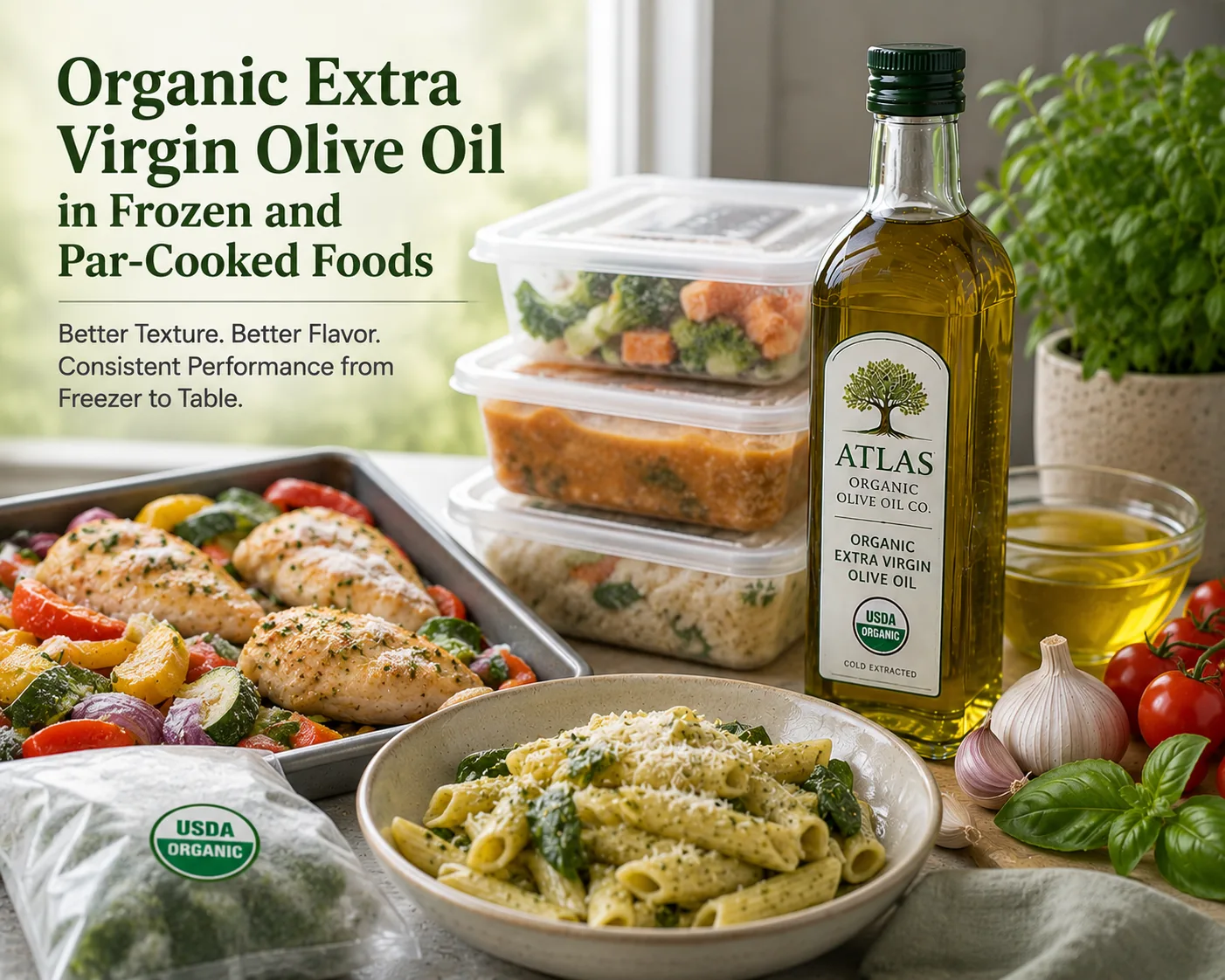
Freezing slows many reactions but does not make formulation or packaging irrelevant. Olive oil can migrate, interact with other fats and change sensory impact after reheating.
Prepared foods add process complexity. Thermal treatment, water activity, starches, proteins, sauces, particulates, freezing rate, frozen storage and packaging all affect how olive oil performs. In par-cooked systems, the oil may also experience more than one heating stage before the consumer eats the product.
The practical objective is not to find an abstract “best” oil. It is to define the oil, inclusion level, stage of addition, process and packaging system that remain fit for the intended frozen or par-cooked food, distribution channel, storage period and reheating method.
1. Start with the decision framework
Before requesting samples, write down the commercial job the oil must perform. That brief should state the frozen-food format, target market, annual and trial volumes, olive-oil use level, expected pack format, sensory role, pre-freeze thermal exposure, frozen storage conditions, reheating method and required organic documentation.
Define where the oil enters the process. Oil used during sautéing or par-cooking receives a different thermal history from oil mixed into a sauce immediately before freezing or added as a finishing component. Those different roles can justify different sensory targets even within the same finished product.
- Evaluate the product after the intended freeze-thaw and consumer reheating cycle.
- Check fat separation, oil migration or emulsion breakdown in sauces and filled products.
- Map where the oil is exposed to pre-cooking, par-cooking, freezing, frozen storage and reheating.
- Protect the product before freezing and during frozen storage from unnecessary oxygen exposure.
- Assess the final product at realistic serving temperature rather than only in the frozen or thawed state.
A useful specification separates the legal or category baseline from tighter internal targets. It also makes clear which values are guaranteed at release, which are typical and which are only reference data from a particular origin or harvest. For frozen foods, internal criteria should also describe acceptable performance after thawing and reheating.
2. Practical workflow
Move from bench evaluation to commercial approval in controlled steps. First, compare candidate oils in the complete formula. Second, reproduce the par-cook and freezing process. Third, hold the product under representative frozen-storage conditions. Finally, evaluate the product after the intended reheating or final-cook step.
- Write a one-page brief. Include olive-oil category, organic status, intended use level, stage of addition, sensory profile, product type, pack, frozen-storage regime, destination and timing.
- Taste the oil neat. Screen for defects and understand fruitiness, bitterness and pungency before evaluating how processing, freezing and reheating alter the sensory profile.
- Sample in the complete formula. Use the actual sauce, starch, protein, vegetable, filling or other components at their intended commercial levels.
- Map thermal exposure. Document sautéing, blanching, baking, par-cooking, hot filling or other pre-freeze heat steps together with the consumer's final reheating method.
- Review documents. Confirm lot identity, analytical results, organic status, traceability and any import, labeling or destination-specific records required by the market.
- Pilot the commercial process. Use representative batch size, heating, transfer, filling, cooling and freezing conditions rather than relying only on small laboratory samples.
- Evaluate frozen-state behavior. Check visible fat migration, oil pooling, phase separation and package integrity during representative frozen storage.
- Run freeze-thaw checks. Where relevant to the commercial route, evaluate whether realistic temperature variation or thawing changes emulsion structure, texture or oil distribution.
- Reheat as the consumer will. Use the intended oven, microwave, stovetop, air fryer or other preparation method and assess aroma, flavor, surface oil, texture and overall eating quality at serving temperature.
- Define release and change control. Decide who approves a new olive-oil lot, use level, freezing condition, sauce system, reheating instruction or package component that could affect the validated product.
The most informative sensory comparison is often the post-reheat product. A delicate oil that seems attractive before freezing may contribute little after par-cooking and reheating, while a moderately robust profile may remain more recognizable in the final eating experience.
3. Quality controls that belong in the conversation
Extra virgin olive oil is defined through more than free acidity. Buyers should use the current applicable category standard, appropriate laboratory methods and—where required—organoleptic assessment. For commercial frozen-food programs, add internal criteria that describe the sensory style the reheated finished product actually needs.
Frozen products introduce additional physical quality questions. Oil can redistribute within sauces, coatings or fillings, and emulsions can change during freezing, thawing and reheating. Those behaviors should be evaluated separately from the incoming olive-oil specification.
- Map every meaningful heat and oxygen exposure step.
- Validate food safety independently from olive-oil quality.
- Set sensory criteria after processing and reheating, not only on incoming oil.
- Track fat migration, oil pooling and emulsion recovery where relevant.
- Validate the finished product in the intended package and frozen-distribution conditions.
For storage and distribution, protect unused oil from direct light, unnecessary heat and repeated oxygen exposure. Once incorporated into the frozen food, package barrier, seal integrity, headspace and the frozen distribution chain become part of the quality system.
Frozen storage should not be treated as proof that oxidation or sensory change stops completely. The product still needs shelf-life validation over the intended storage period, and the final evaluation should include thawing or reheating because defects may become more noticeable when the product warms.
4. Common failure modes
Most problems are not caused by the absence of a premium ingredient. They arise when frozen storage is assumed to stop all quality change, when the product is evaluated only before freezing, or when post-thaw and reheating behavior is not included in development.
- Assuming frozen storage stops oxidation entirely.
- Evaluating only the pre-freeze product and not the reheated finished food.
- Ignoring reheating method when setting sensory targets.
- Failing to assess emulsion recovery after thawing.
- Ignoring oil migration or pooling in filled products and sauces.
- Using a delicate sensory profile that is largely lost through par-cooking and reheating.
- Changing the package or freezing process without reviewing the original shelf-life validation.
Another common weakness is testing only ideal frozen storage. Real distribution can include staging, loading, transfer and other handling events. Development programs should represent the commercial frozen chain closely enough to identify whether temperature variation affects texture, oil distribution or final sensory quality.
Build corrective-action triggers around objective evidence: out-of-spec incoming results, sensory defects, oil pooling, emulsion failure, damaged seals, broken traceability, temperature excursions, packaging failures or documented process deviations.
5. What to put in the purchase specification
The olive-oil specification should support the frozen or par-cooked product without attempting to replace finished-product validation. Define the incoming oil characteristics that matter, then document the process, freezing, package and reheating conditions used to qualify the complete system.
6. Reference framework
For category definitions, analytical methods and organoleptic assessment, use the current International Olive Council trade standard and methods together with destination-market rules. These references define the incoming olive-oil category; they do not determine freeze-thaw behavior, frozen shelf life or post-reheat sensory performance.
Finished-product validation should reflect the complete commercial system, including olive-oil use level, stage of addition, par-cook conditions, sauce or filling system, freezing, frozen storage, package and consumer reheating. Food-safety controls should be validated separately from olive-oil quality.
Next step
Turn this guide into a sourcing brief by listing your frozen or par-cooked food type, annual volume, destination, target olive-oil inclusion, stage of addition, par-cook conditions, freezing method, package format, storage regime, reheating method, launch date and the sensory attributes that matter most.
Atlas can then compare suitable organic olive-oil programs on the same commercial basis, aligning category, sensory profile, process fit, freeze-thaw performance, packaging, documentation and repeat-supply requirements with the complete frozen-food system.