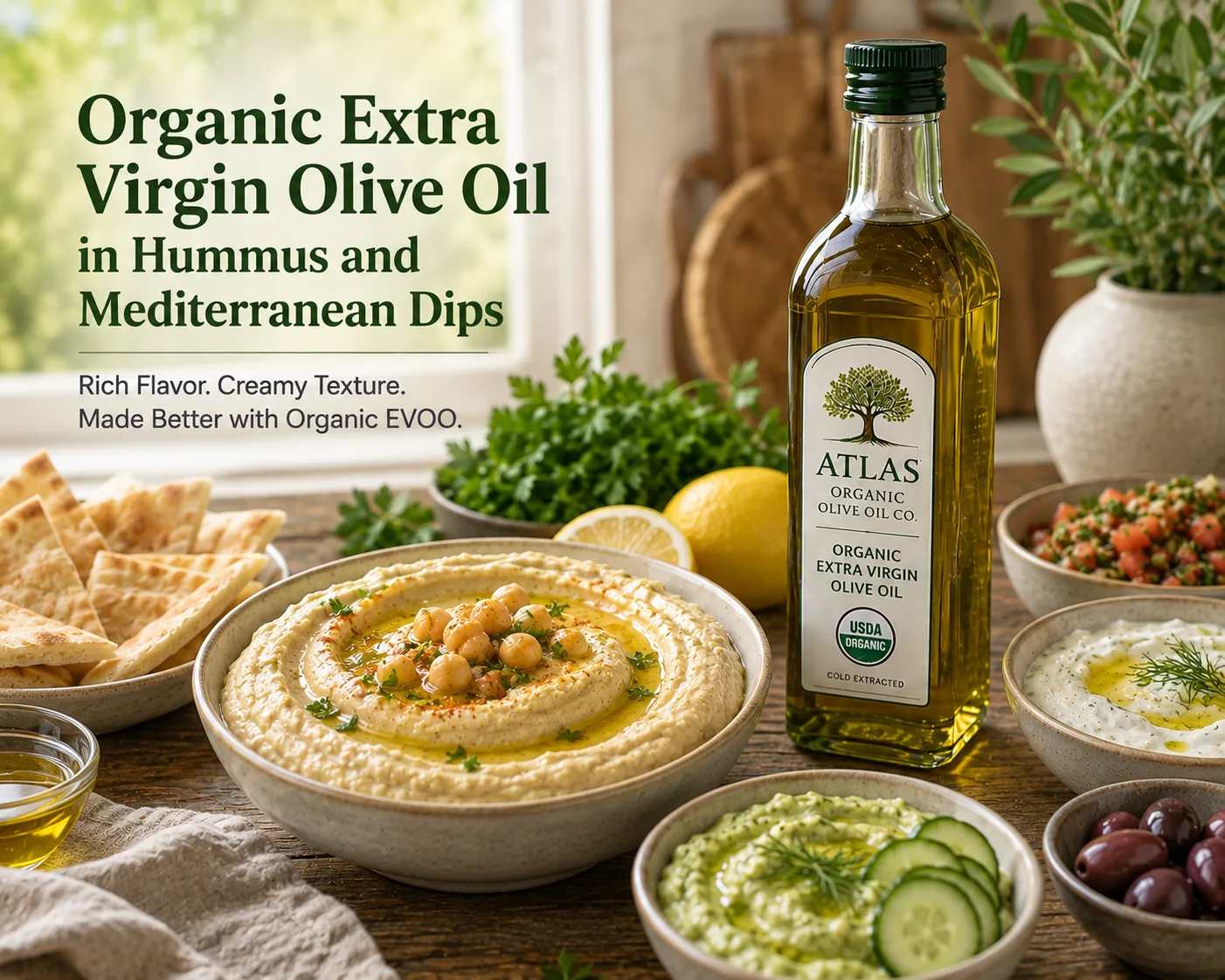
Hummus and similar dips use olive oil for richness, aroma and finish. The decision is less about maximizing intensity and more about matching fruitiness and pungency to chickpea, tahini, garlic, lemon and spice.
Treat the oil as part of the full food system. Chickpea solids, tahini, lemon or other acids, garlic, herbs, spices, water, proteins, salt, process shear and package oxygen can all influence flavor, texture and oxidative behavior. Olive oil that tastes balanced on its own may behave differently once dispersed through a dense, savory dip.
The practical objective is not to find an abstract “best” oil. It is to define the oil profile, inclusion level, finishing role, process and packaging system that remain fit for the intended dip, distribution channel and shelf life. Mixed-in oil and garnish oil can be treated as separate formulation decisions when they perform different sensory jobs.
1. Start with the decision framework
Before requesting samples, write down the commercial job the oil must perform. That brief should state the dip style, target market, annual and trial volumes, mixed-in oil level, finishing-oil requirement, expected pack format, sensory role, process exposure, refrigerated storage conditions and required organic documentation.
Flavor balance should be assessed in the complete formula. Tahini can contribute its own bitterness and roasted character, lemon changes brightness and perceived pungency, garlic can dominate aroma, and spices may either reinforce or mask olive notes. For that reason, neat-oil tasting is useful for defect screening but is not sufficient for final selection.
- Taste candidate oils in the full dip, not only as a surface garnish.
- Separate oil used inside the emulsion from finishing oil if different sensory jobs are needed.
- Evaluate fruitiness, bitterness and pungency against the actual chickpea, tahini, garlic, lemon and spice system.
- Monitor oil separation, gloss, spreadability and mouthfeel in the finished refrigerated product.
- Account for package headspace, refrigerated distribution and consumer reclosure in shelf-life work.
A useful specification separates the legal or category baseline from tighter internal targets. It also makes clear which values are guaranteed at release, which are typical and which are only reference data from a particular origin or harvest. For hummus and dips, internal sensory criteria should describe the finished product rather than the olive oil in isolation.
2. Practical workflow
Move from bench formulation to commercial approval in controlled steps. First, compare candidate oils in the complete dip. Second, reproduce the intended blending or homogenization process. Third, evaluate texture and oil separation in the actual package. Finally, validate flavor, physical stability and refrigerated shelf life under the intended distribution conditions.
- Write a one-page brief. Include olive-oil category, organic status, mixed-in oil level, finishing-oil requirement, sensory target, tahini level, pack, volume, destination and timing.
- Taste the oil neat. Screen for defects and understand its starting fruitiness, bitterness and pungency before evaluating how those characteristics interact with chickpea, tahini, garlic and lemon.
- Build the complete formula. Test candidate oils with the actual chickpea base, tahini, acids, garlic, salt, herbs, spices and any stabilizing ingredients used in the commercial product.
- Compare mixed-in and finishing roles. Where relevant, evaluate a milder oil inside the dip and a more aromatic oil as a garnish, rather than assuming one profile must perform both functions.
- Review documents. Confirm lot identity, analytical results, organic status, traceability and any import, labeling or destination-specific records required by the market.
- Pilot the process. Use commercial-equivalent hydration, cooking where applicable, grinding, blending, shear, cooling and filling conditions rather than relying only on hand-prepared samples.
- Evaluate physical behavior. Track spreadability, viscosity, gloss, visible oiling-off, water separation and texture at the intended refrigerated serving temperature.
- Validate finishing presentation. If oil is added on top, assess appearance, pooling, absorption into the dip and sensory contribution through the expected storage period.
- Validate the package. Test the intended tub, cup, tray or foodservice format with realistic fill level, headspace, seal integrity, light exposure, refrigerated storage and consumer reclosure where applicable.
- Define release and change control. Decide who approves a new olive-oil lot, tahini source, garlic or spice system, process condition, oil level or package component that could affect the validated product.
Sensory evaluation should be performed at realistic serving temperature. Refrigeration can reduce aroma release and alter texture perception, so a candidate oil that seems restrained when cold may become more evident as the dip warms during service.
3. Quality controls that belong in the conversation
Extra virgin olive oil is defined through more than free acidity. Buyers should use the current applicable category standard, appropriate laboratory methods and—where required—organoleptic assessment. For commercial hummus and dip programs, add internal criteria that describe the sensory style the finished refrigerated product actually needs.
Finished-product quality control should then consider the complete system. Tahini, garlic, acid level, spice intensity, processing shear and package oxygen can all change how olive-oil quality is perceived. Physical separation and oxidative deterioration should also be tracked independently because one can occur without the other.
- Evaluate candidate oils in the complete formula at the target mixed-in use level.
- Run pilot processing with representative time, temperature and shear conditions.
- Track oil separation, spreadability and mouthfeel through refrigerated storage.
- Evaluate finishing oil separately where a visible garnish is part of the product design.
- Validate the finished product in the intended package and distribution conditions.
For storage and distribution, protect unused olive oil from direct light, unnecessary heat and repeated oxygen exposure. Once incorporated into the dip, package headspace, oxygen permeability, seal quality and refrigerated handling become part of the finished-product quality system.
Multi-serve packaging requires additional attention because consumer reclosure can introduce repeated oxygen exposure and disturb the oil layer on the surface. Shelf-life work should therefore reflect the expected use pattern where that behavior is commercially relevant.
4. Common failure modes
Most problems are not caused by the absence of a premium oil. They arise when the same sensory target is used for mixed-in and finishing oil, when strong garlic or spice masks developing defects, or when oil separation is ignored during refrigerated storage.
- Using one sensory target for both mixed-in and garnish oil.
- Selecting an oil on neat tasting without evaluating the full chickpea and tahini system.
- Masking developing rancid or stale notes with strong garlic or spice during QC.
- Ignoring oil separation or pooling behavior in the finished pack.
- Evaluating only day-zero texture instead of refrigerated texture over shelf life.
- Ignoring consumer reclosure and repeated oxygen exposure in multi-serve tubs.
- Changing tahini source, garlic level or processing shear without reviewing the original oil validation.
Another common weakness is assuming that a highly pungent oil will automatically make the product taste more premium. In a formula already containing tahini bitterness, garlic and spice, excessive pungency can reduce balance rather than improve it. The appropriate target is the sensory profile of the complete dip.
Build corrective-action triggers around objective evidence: out-of-spec incoming results, sensory defects, excessive oiling-off, water separation, unexpected texture drift, damaged seals, broken traceability, temperature excursions, packaging failures or documented process deviations.
5. What to put in the purchase specification
The olive-oil specification should support the hummus or dip formulation without attempting to replace finished-product validation. Define the incoming oil characteristics clearly, then document the formula, process, mixed-in and finishing roles, package and refrigerated-storage conditions used to qualify the complete system.
6. Reference framework
For category definitions, analytical methods and organoleptic assessment, use the current International Olive Council trade standard and methods together with destination-market rules. These references define the incoming olive-oil category; they do not determine texture, refrigerated stability or sensory performance in a multi-ingredient hummus or dip.
Finished-product validation should reflect the complete commercial system, including mixed-in oil level, finishing oil where used, chickpea or pulse base, tahini, acid, garlic, spices, process shear, package, refrigerated storage and consumer use pattern. The most useful sourcing decision is therefore based on performance in the finished dip.
Next step
Turn this guide into a sourcing brief by listing your hummus or Mediterranean-dip style, annual volume, destination, mixed-in olive-oil level, finishing-oil requirement, tahini level, acid and spice system, process conditions, pack format, refrigerated shelf life and target launch date.
Atlas can then compare suitable organic olive-oil programs on the same commercial basis, aligning category, sensory profile, formulation fit, finishing role, packaging, documentation and repeat-supply requirements with the complete hummus or Mediterranean-dip system.