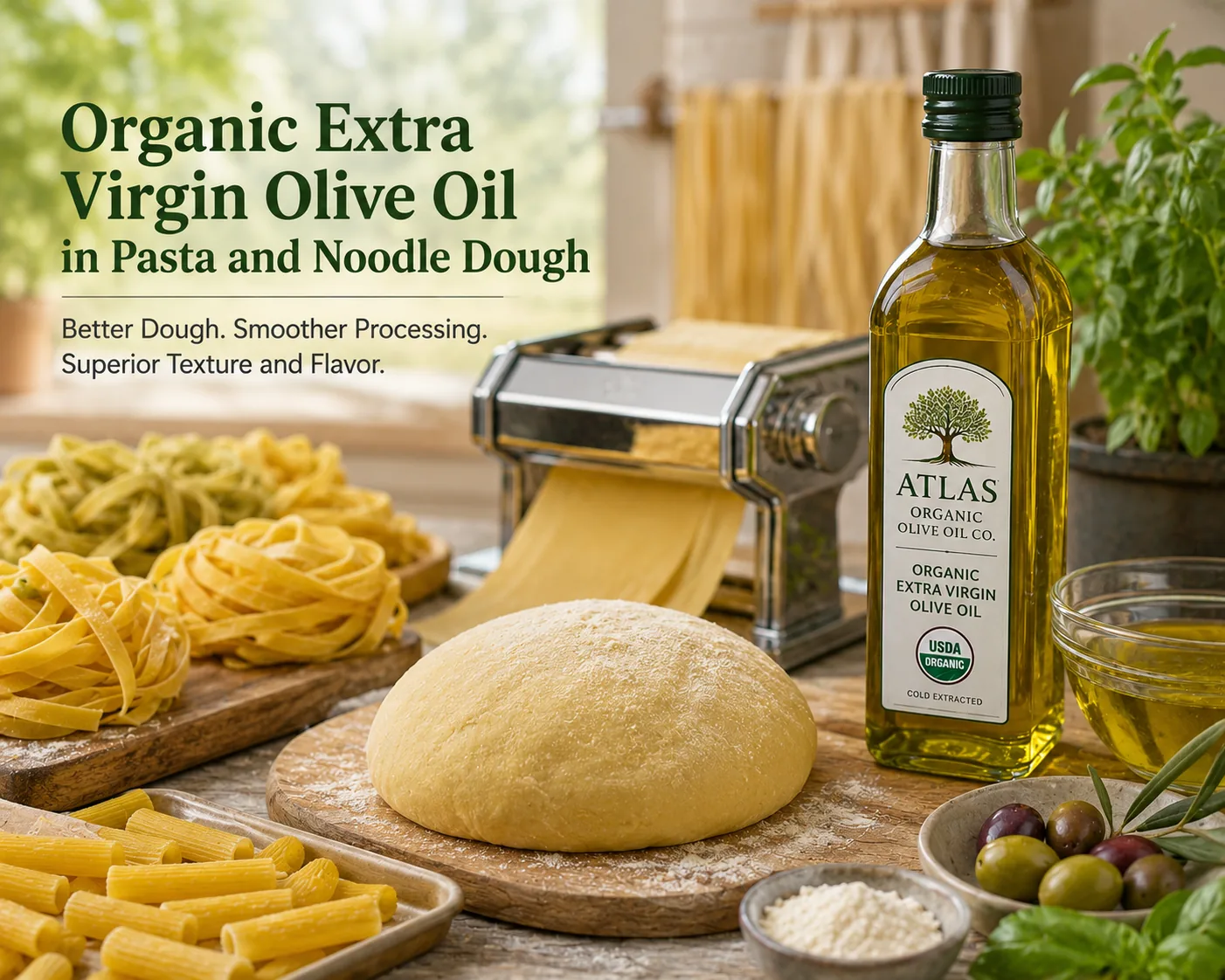
Olive oil is generally a minor component in pasta or noodle dough, but it can influence handling, mouthfeel and flavor. Its value should be judged against process performance and the finished cooked product.
Treat the oil as part of the full dough system. Flour or semolina type, protein strength, hydration, eggs or other binders, salt, mixing energy, extrusion or sheeting conditions, drying and cooking all influence the final result. A change in olive oil may therefore be noticed first in processing behavior rather than in neat sensory evaluation.
The practical objective is not to find an abstract “best” oil. It is to define the oil, inclusion rate and handling system that remain fit for the intended pasta or noodle style, production line, channel and shelf life. Because use levels are often modest, the most intense oil is not automatically the most commercially useful choice.
1. Start with the decision framework
Before requesting samples, write down the commercial job the oil must perform. That brief should state the pasta or noodle type, target market, annual and trial volumes, oil inclusion level, flour or semolina system, process route, expected pack format, sensory role, storage conditions and required organic documentation.
Define whether olive oil is included mainly to support dough handling and mouthfeel or whether a recognizable olive character is part of the finished-product identity. In many products, cooking and the relatively low oil inclusion reduce sensory visibility, so process consistency can be more commercially important than a highly aromatic incoming profile.
- Run side-by-side dough handling trials at production scale before changing oil source.
- Measure any impact on mixing, extrusion, sheeting, cutting, drying or cooking quality.
- Keep the oil inclusion fixed during supplier comparisons so process differences are easier to interpret.
- Evaluate the cooked product as well as raw dough or dried pasta.
- Use a restrained sensory profile unless olive character is a deliberate product feature.
A useful specification separates the legal or category baseline from tighter internal targets. It also makes clear which values are guaranteed at release, which are typical and which are only reference data from a particular origin or harvest. For pasta and noodles, internal performance targets should also identify the production variables that must remain stable during qualification.
2. Practical workflow
Move from sample evaluation to commercial approval in controlled steps. First, compare candidate oils in the intended dough formula. Second, reproduce the actual extrusion, sheeting or forming process. Third, evaluate drying, cooking and finished sensory quality. Finally, define receiving and change-control procedures so future lots are assessed consistently.
- Write a one-page brief. Include olive-oil category, organic status, intended inclusion level, sensory profile, dough type, flour or semolina base, process route, pack, volume, destination and timing.
- Taste the oil neat. Screen for defects and understand its fruitiness, bitterness and pungency before determining whether those characteristics remain noticeable after processing and cooking.
- Run controlled dough trials. Keep flour, hydration, mixing time, rest conditions and olive-oil inclusion consistent when comparing candidate oils so differences can be attributed more reliably.
- Measure process behavior. Observe dough cohesion, stickiness, extensibility and machinability during mixing, extrusion, sheeting, cutting or forming as applicable.
- Review documents. Confirm lot identity, analytical results, organic status, traceability and any import, labeling or destination-specific records required by the market.
- Pilot the production line. Use commercial-equivalent batch size, mixing energy, extrusion pressure, sheeting, cutting or forming conditions rather than relying only on bench dough.
- Evaluate drying or chilling. Where applicable, check how the oil-containing dough behaves through the actual drying, cooling or refrigerated-storage process.
- Cook the finished product. Assess cooking tolerance, firmness, surface condition, stickiness, mouthfeel and sensory contribution under the preparation method expected for the final product.
- Validate packaging and storage. Evaluate the finished dry, chilled or other pasta/noodle format in its intended package and distribution conditions.
- Define release and change control. Decide who approves a new harvest, olive-oil lot, oil inclusion, flour system, process condition or packaging component that could affect the validated product.
Production-scale trials are particularly important when the process is sensitive to small changes in dough consistency. A bench sample may look acceptable while differences become more obvious under continuous extrusion, high-throughput sheeting or long drying cycles.
3. Quality controls that belong in the conversation
Extra virgin olive oil is defined through more than free acidity. Buyers should use the current applicable category standard, appropriate laboratory methods and—where required—organoleptic assessment. For commercial pasta and noodle programs, add internal criteria that describe the sensory profile actually needed at the finished cooked-product stage.
Quality control should also include process performance. An incoming oil can meet all analytical requirements yet still require validation when a change in source or inclusion affects mixing, extrusion, sheeting, drying or cooked texture. These are finished-process questions rather than olive-oil category questions.
- Evaluate candidate oils in the complete dough formula at the target use level.
- Run pilot processing with the commercial mixing, extrusion or sheeting profile.
- Track drying, chilling or storage behavior where relevant to the product format.
- Evaluate the cooked product for texture, surface condition, mouthfeel and sensory balance.
- Validate the finished product in the intended package and distribution conditions.
For storage and distribution, protect unused olive oil from direct light, unnecessary heat and repeated oxygen exposure. A premium incoming lot can deteriorate if it is held too warm, repeatedly opened or stored in a partly empty container for long periods before use.
The final product's storage needs depend on format. Dry pasta, fresh chilled noodles and filled or semi-prepared products have different shelf-life systems, so olive-oil quality should be considered within the actual finished-product process rather than used as a substitute for product-specific validation.
4. Common failure modes
Most problems are not caused by the absence of a premium ingredient. They arise when a small oil inclusion is given more importance than production performance, when bench behavior is assumed to scale directly, or when the cooked product is not evaluated.
- Overstating nutritional or health claims from a relatively small olive-oil inclusion.
- Assuming bench dough behavior will scale directly to extrusion or sheeting equipment.
- Changing oil source without checking dough cohesion, stickiness or machinability.
- Paying for sensory intensity that is not perceptible after drying and cooking.
- Evaluating only raw dough instead of the finished cooked pasta or noodles.
- Changing flour, hydration or oil level at the same time and then attributing all effects to the oil.
- Ignoring package and storage requirements for fresh or chilled noodle formats.
Another common weakness is qualifying a new oil without a stable process baseline. If hydration, mixing energy, rest time or drying conditions also change during the trial, it becomes difficult to distinguish oil-related effects from normal process variation.
Build corrective-action triggers around objective evidence: out-of-spec incoming results, sensory defects, abnormal dough handling, extrusion or sheeting problems, unexpected cooking loss or stickiness, damaged seals, broken traceability, temperature excursions or documented process deviations.
5. What to put in the purchase specification
The olive-oil specification should support the pasta or noodle process without attempting to replace finished-product validation. Define the incoming oil characteristics that matter, then document the process and cooked-product criteria used to qualify the complete system.
6. Reference framework
For category definitions, analytical methods and organoleptic assessment, use the current International Olive Council trade standard and methods together with destination-market rules. These references define the incoming olive-oil category; they do not determine dough behavior, drying performance or cooked pasta quality.
Finished-product validation should reflect the complete commercial system, including flour or semolina, hydration, olive-oil inclusion, mixing, extrusion or sheeting, drying or chilling, packaging and cooking. The most useful sourcing decision is therefore based on production-scale performance and the finished cooked product.
Next step
Turn this guide into a sourcing brief by listing your pasta or noodle type, annual volume, destination, target olive-oil inclusion, flour or semolina base, extrusion or sheeting process, drying or chilling system, pack format, target launch date and the quality attributes that matter most.
Atlas can then compare suitable organic olive-oil programs on the same commercial basis, aligning category, sensory profile, dough performance, process fit, packaging, documentation and repeat-supply requirements with the complete pasta or noodle production system.