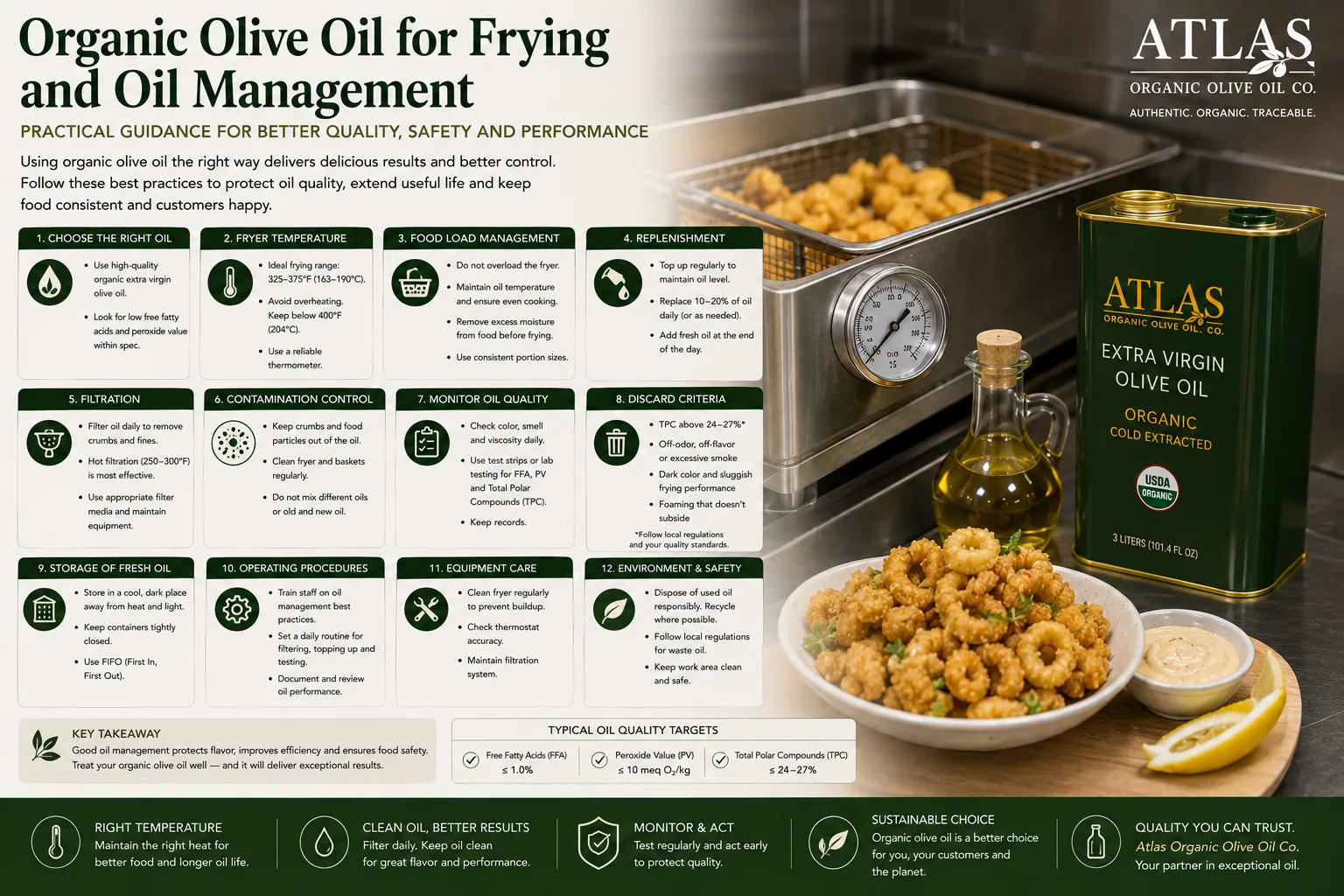
Frying performance depends on oil composition, temperature, food load, turnover, contamination and local food-service rules. Olive oil can be used for frying, but an operating program should be validated for the specific kitchen or production line.
Foodservice quality depends on operating discipline. Pack turnover, storage location, actual fryer temperature, replenishment frequency, filtration and staff practices can matter as much as the starting oil. Two kitchens using the same oil can therefore experience different results when their equipment, menu mix and operating procedures differ.
The practical objective is not to identify one abstract “best” frying oil. It is to define the oil, fryer conditions and handling routine that remain fit for the intended food, service pattern and quality expectations. Procurement and kitchen operations should therefore be designed as one system rather than treating the ingredient specification independently from daily fryer management.
1. Start with the decision framework
Before requesting samples, write down the commercial job the oil must perform. That brief should state the food application, target market, annual and trial volumes, expected pack format, desired sensory role, fryer type, operating temperature, typical food load, storage conditions and required organic documentation.
Add the real service pattern to the brief. A high-turnover fryer processing continuous loads operates differently from a fryer that spends long periods hot and idle. Food moisture, breading, crumbs, seasonings and cross-contact from different menu items can also affect oil condition and should be considered during testing.
- Control actual fryer temperature and avoid unnecessary overheating between loads.
- Define realistic food loads, idle periods and peak-service patterns during pilot testing.
- Track replenishment, filtration, food debris and discard criteria using a written oil-management procedure.
- Keep water, excessive crumbs and burned food particles from accumulating in the fryer where practical.
- Pilot the selected olive-oil grade and style with the real food, equipment and service pattern before full rollout.
A useful specification separates the legal or category baseline from tighter internal targets. It also makes clear which values are guaranteed at release, which are typical, and which are only reference data from a particular origin or harvest. For frying programs, the operating procedure should provide the same clarity by distinguishing routine controls from conditions that require investigation or oil replacement.
2. Practical workflow
Move from sample evaluation to commercial fryer approval in controlled steps. First, screen candidate oils for incoming quality and sensory suitability. Second, test them with the actual foods and equipment. Third, establish the replenishment, filtration and discard routine. Finally, train receiving and kitchen teams to apply the same operating rules during normal service.
- Write a one-page brief. Include olive-oil category, organic status, sensory profile, pack size, fryer type, operating temperature, menu application, volume, destination and expected timing.
- Check the equipment. Confirm that temperature controls and operating procedures are suitable for the intended frying program. Actual oil temperature should be understood rather than assumed solely from the fryer setting.
- Sample in context. Taste the oil neat for defects and style, then fry the real food. Evaluate flavor transfer, browning, aroma, mouthfeel and whether the oil profile supports or competes with the intended menu item.
- Define the service cycle. Reproduce realistic load size, interval between batches, idle periods, peak demand and daily operating time rather than testing only under unusually gentle conditions.
- Review documents. Confirm lot identity, analytical results, organic status, traceability and any import, foodservice or destination-specific records required by the market.
- Set replenishment and filtration rules. Define when fresh oil is added, how crumbs and food particles are removed and how staff record maintenance activities when the operation requires documented control.
- Define discard criteria. Use the site's approved sensory, physical, operational or regulatory criteria rather than relying only on color, elapsed time or a fixed number of frying cycles.
- Pilot the complete system. Use commercial-equivalent food loads, equipment, temperatures, filtration and service duration before approving the oil for broad rollout.
- Define release and change control. Decide who approves a new oil category, harvest, supplier lot, pack format, fryer condition or material operating-procedure change.
A successful frying trial should test the operating routine as well as the oil. If the pilot is carefully managed by a development team but the commercial kitchen will use different filtration, food loads or idle temperatures, the trial may not predict everyday performance accurately.
3. Quality controls that belong in the conversation
Extra virgin olive oil is defined through more than free acidity. Buyers should use the current applicable category standard, appropriate laboratory methods and—where required—organoleptic assessment. For commercial programs, add internal criteria that describe the sensory style the foodservice application actually needs.
Frying quality control then adds an operational layer. Starting-oil quality matters, but so do temperature, water exposure, food debris, replenishment, filtration and time under heat. These variables should be managed consistently if different sites are expected to deliver comparable results.
- Size packs around actual use rate so opened inventory turns over at a practical pace.
- Keep reserve stock away from direct light, unnecessary heat and contamination sources.
- Write practical opening, decanting, fryer-filling, filtration, replenishment and discard procedures.
- Record operating observations consistently where multiple sites or shifts must follow the same program.
- Investigate unexpected foaming, off-odors, excessive darkening or rapid deterioration instead of simply adding fresh oil.
For storage and distribution, protect unused oil from direct light, unnecessary heat and repeated oxygen exposure. A premium incoming lot can deteriorate before it reaches the fryer if it is stored near heat-producing equipment, left in direct sun or kept in a partly empty open container for too long.
Opened containers should also match the site's consumption rate. A larger package may reduce handling frequency but can create a longer opened-life period in a low-volume kitchen. Pack size should therefore be selected with real turnover and storage practices in mind rather than cost per unit alone.
4. Common failure modes
Most frying problems are not caused by a lack of supplier claims. They arise when equipment and operating conditions are poorly controlled, when conclusions from one test are generalized too broadly, or when staff practices allow contamination and unnecessary heat exposure to accumulate.
- Making universal frying-performance claims from one laboratory, fryer or kitchen study.
- Assuming the thermostat setting always equals the actual oil temperature.
- Topping up degraded oil repeatedly without monitoring the condition of the total fryer contents.
- Allowing breading debris, crumbs, water or burned particles to accelerate deterioration.
- Keeping fryers unnecessarily hot during long idle periods.
- Using the same discard interval regardless of food load, fryer size, replenishment or filtration practice.
- Storing reserve oil beside the fryer, hot equipment or direct sunlight.
Another common mistake is judging oil condition from appearance alone. Color changes can be influenced by the foods being fried, seasonings, breading and accumulated particles. Operational decisions should use the complete set of criteria adopted by the site rather than one visual cue in isolation.
Build corrective-action triggers around objective evidence: out-of-spec incoming results, unexpected sensory deterioration, overheating events, contamination, abnormal foaming, equipment problems, broken traceability, damaged packaging or documented process deviations. This creates a clearer basis for retraining, investigation or oil replacement.
5. What to put in the purchase specification
The purchase specification should define the incoming oil clearly while the operating procedure defines how it will be used. Keeping those two documents aligned helps prevent a technically suitable oil from performing poorly because the fryer program differs from the conditions validated during development.
6. Reference framework
For category definitions, analytical methods and organoleptic assessment, use the current International Olive Council trade standard and methods together with destination-market rules. Frying operations should also follow the food-safety and foodservice requirements applicable to the specific market and facility.
Commercial frying performance should be validated in the actual operating system because temperature, fryer design, food load, moisture, replenishment, filtration and service pattern can all change oil behavior. Supplier information can support oil selection, but the buyer or operator still needs a practical site-specific oil-management procedure.
Next step
Turn this guide into a sourcing brief by listing your fried-food application, annual oil volume, destination, fryer type, operating temperature, daily service pattern, desired pack format and target launch date. Add your filtration, replenishment and discard approach if those procedures are already defined.
Atlas can then compare suitable organic olive-oil programs on the same commercial basis, aligning incoming quality, sensory profile, pack turnover, documentation and supply format with the realities of the frying operation rather than evaluating the oil independently from the kitchen or production system.