
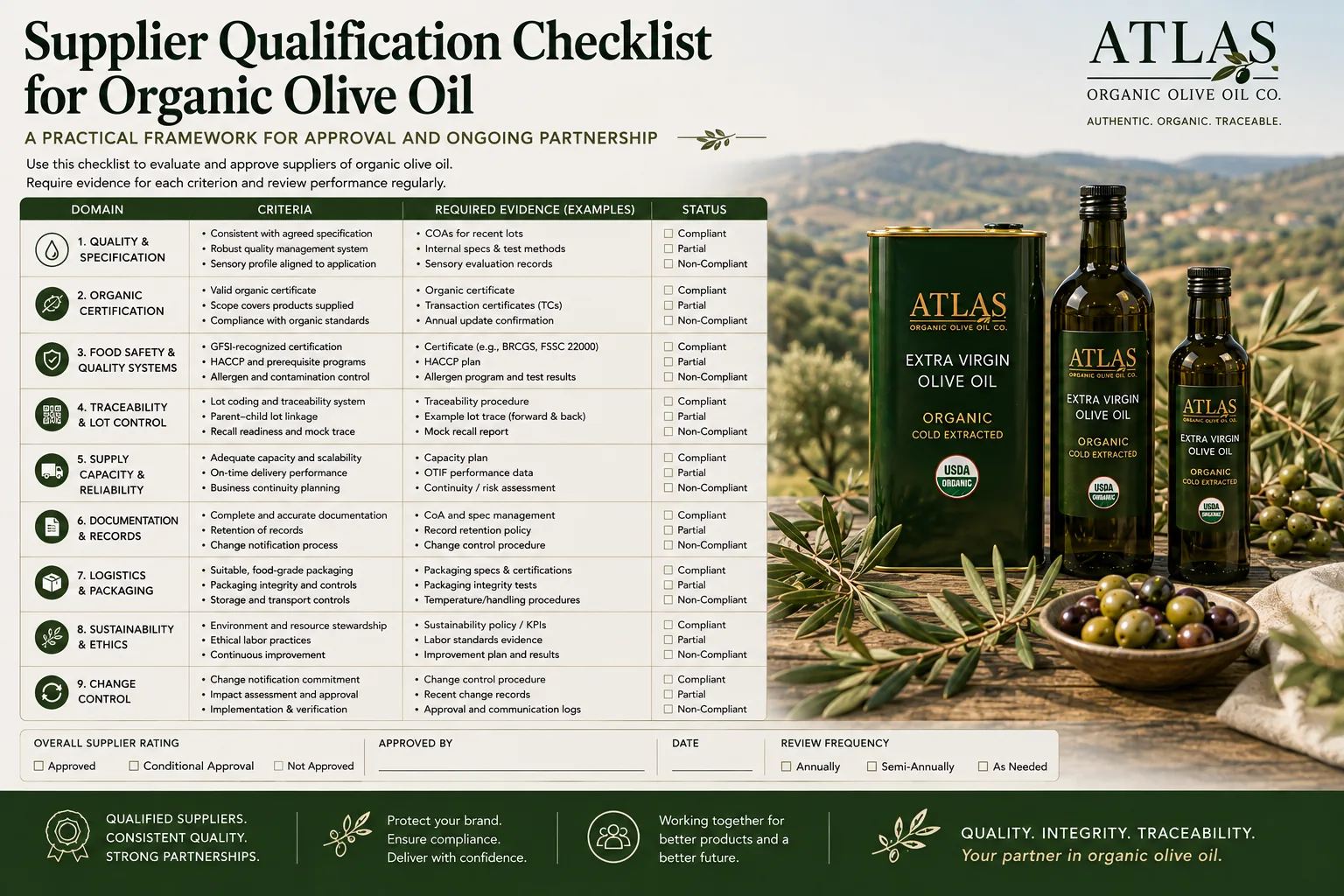
Supplier approval should test whether a partner can repeatedly deliver the agreed oil, not just whether a first sample tastes good. Quality, organic scope, traceability, capacity, food safety and communication all matter when the objective is repeatable commercial supply.
Procurement translates desired quality into a repeatable supply system. Specification, supplier qualification, forecast, documentation, logistics, change control and dispute rules should be decided before scale-up. A strong initial sample is useful evidence, but it does not demonstrate whether the supplier can reproduce the required quality through harvest transitions, larger volumes and routine shipments.
The practical objective is not to find an abstract “best” oil or the supplier with the longest presentation. It is to confirm that the organization, facilities, processes and controls behind the offer can reliably deliver oil that remains fit for the intended food, channel and shelf life.
1. Start with the decision framework
Before requesting samples, write down the commercial job the oil must perform. That brief should state the finished product or service application, target market, annual and trial volumes, expected pack format, sensory role, process exposure, storage conditions and required organic documentation. If the oil will be named prominently on the label, the sensory target deserves even more attention.
Supplier qualification should then examine the organization that will deliver that brief. Identify the contracting legal entity, the actual mill or source where relevant, storage locations, packing facilities, laboratories, third-party warehouses and any brokers or co-packers involved. Knowing who sells the oil is not always the same as understanding who handles it.
- Request legal entity, site, food-safety, organic, product, laboratory and traceability documents in one controlled file.
- Confirm which production, storage and packing locations are included in the supplier's certification and approval scope.
- Audit or risk-assess the mill, storage and packing operations that can materially affect the oil.
- Ask how harvest transitions, lot changes, substitutions and specification changes are communicated.
- Use trial lots to test document accuracy, packing, communication and delivery performance before scaling.
A useful specification separates the legal or category baseline from tighter internal targets. It also makes clear which values are guaranteed at release, which are typical, and which are only reference data from a particular origin or harvest. Supplier qualification should confirm that the seller understands these distinctions and has systems capable of managing them.
2. Practical workflow
Move from supplier screening to commercial approval in controlled steps. First, establish what the supplier must deliver. Second, review the legal, quality, food-safety, organic and operational documentation behind the offer. Third, test the actual oil and handling system. Finally, approve the supplier only after the product, documents, packaging and communication perform together.
- Write a one-page brief. Include category, organic status, harvest or filtration preference if relevant, sensory profile, pack, annual and trial volume, destination and expected timing.
- Map the supply chain. Identify the legal seller, production or milling location where relevant, storage tanks, packing site, warehouse, laboratory and any third parties that can materially affect product identity or quality.
- Sample in context. Taste the oil neat for defects and style, then evaluate it in the actual food, process or service condition. Compare the approved sample with the commercial lot when the first order arrives.
- Review documents. Confirm lot identity, analytical results, organic status, traceability, food-safety documentation and any import or label records required by the destination market.
- Check scope and validity. A certificate is useful only if it is current and applies to the relevant entity, site, activity and product. Record expiry dates and define who is responsible for monitoring renewals.
- Assess capacity and continuity. Compare expected annual demand, peak requirements, minimum order quantities and lead times with the supplier's realistic available capacity. Ask how seasonal or harvest transitions will be managed.
- Pilot the system. Use a commercial-equivalent order to test documentation, packing, palletization, lot coding, communication, shipping and delivery rather than approving the supplier from laboratory samples alone.
- Define release and change control. Decide who approves a new harvest, new lot, origin change, new pack component, production-site change or material specification change before affected product enters routine supply.
A trial shipment can reveal issues that paperwork does not. Incomplete shipping documents, unreadable lot codes, poorly secured pallets, unexpected pack dimensions or slow responses to routine questions are all useful supplier-performance information before volumes increase.
3. Quality controls that belong in the conversation
Extra virgin olive oil is defined through more than free acidity. Buyers should use the current applicable category standard, appropriate laboratory methods and—where required—organoleptic assessment. For commercial programs, add internal criteria that describe the sensory style your brand or formulation actually needs.
Supplier qualification should confirm how those controls are performed. Ask which laboratory conducts routine testing, how samples are identified, how non-conforming results are handled and whether the certificate of analysis is linked clearly to the shipped commercial lot. Where sensory approval is material, define who evaluates the oil and what happens when a new lot differs noticeably from the approved reference.
- Separate legal category minimums from tighter internal quality and sensory targets.
- Qualify the handling chain, not only the seller or broker issuing the quotation.
- Confirm that certificates and laboratory results can be linked to the actual shipped lot.
- Build harvest transitions and expected natural variation into the commercial agreement.
- Define how out-of-specification results, complaints and corrective actions will be communicated.
For storage and distribution, protect oil from direct light, unnecessary heat and repeated oxygen exposure. A premium incoming lot can deteriorate if it is held too warm, transferred turbulently, stored in a partly empty container for too long or packed in a format that does not suit turnover.
This is why supplier qualification should include the storage and packing environment where relevant. Tank condition, segregation, transfer practices, closure control, cleanliness, lot identification and stock rotation can all influence whether the quality measured at production survives until dispatch.
4. Common failure modes
Most supplier-approval problems are not caused by a lack of paperwork. They arise when documents are accepted without checking their scope, when the commercial handling chain is not understood, or when the first sample is treated as proof of long-term capability.
- Approving a broker or sales office without understanding the actual production, storage and packing chain.
- Accepting certificates without checking their scope, issuing entity, site coverage and validity period.
- Skipping capacity, lead-time and harvest-continuity questions before committing commercial volume.
- Approving a polished pre-shipment sample without comparing it with the first routine commercial lot.
- Failing to define how supplier, origin, harvest, packaging or specification changes must be notified.
- Keeping quality, organic and commercial documents in separate systems that cannot be reconciled by lot.
- Ignoring response time and corrective-action quality when evaluating supplier performance.
Another common weakness is approving the product but not the process behind it. The same oil can pass through different tanks, warehouses, fillers or logistics routes, and those operations may materially affect traceability or quality. Qualification should therefore follow the relevant product path rather than stopping at the company name on the invoice.
Build corrective-action triggers around objective evidence: out-of-spec results, sensory defects, damaged seals, broken traceability, temperature excursions, packaging failures, missing documents, late notifications or documented process deviations. This makes supplier conversations faster and fairer because escalation is tied to agreed evidence rather than subjective dissatisfaction.
5. What to put in the purchase specification
The purchase specification should define the oil clearly enough to support repeat supply and should be read together with the supplier-qualification file. Product parameters control what is delivered; supplier controls establish confidence in how consistently those parameters can be achieved.
6. Reference framework
For category definitions, analytical methods and organoleptic assessment, use the current International Olive Council trade standard and methods together with destination-market rules. Organic status, food-safety and import requirements should also be reviewed against the current rules and certification frameworks applicable to the specific supply chain.
Internal supplier-approval procedures should complement those external requirements by defining document review, risk classification, audit expectations, approval authority, requalification frequency and change-control responsibilities. The objective is a controlled commercial system, not simply a larger folder of certificates.
Next step
Turn this guide into a sourcing brief by listing your application, annual and trial volume, destination, desired format, target launch date and the quality attributes that matter most. Add your required organic scope, supplier documents, food-safety expectations, capacity assumptions and any change-control requirements.
Atlas can then compare suitable organic olive-oil programs on the same commercial basis, including product quality, certification, traceability, packing capability, logistics and supplier continuity rather than evaluating the first sample or headline price in isolation.