
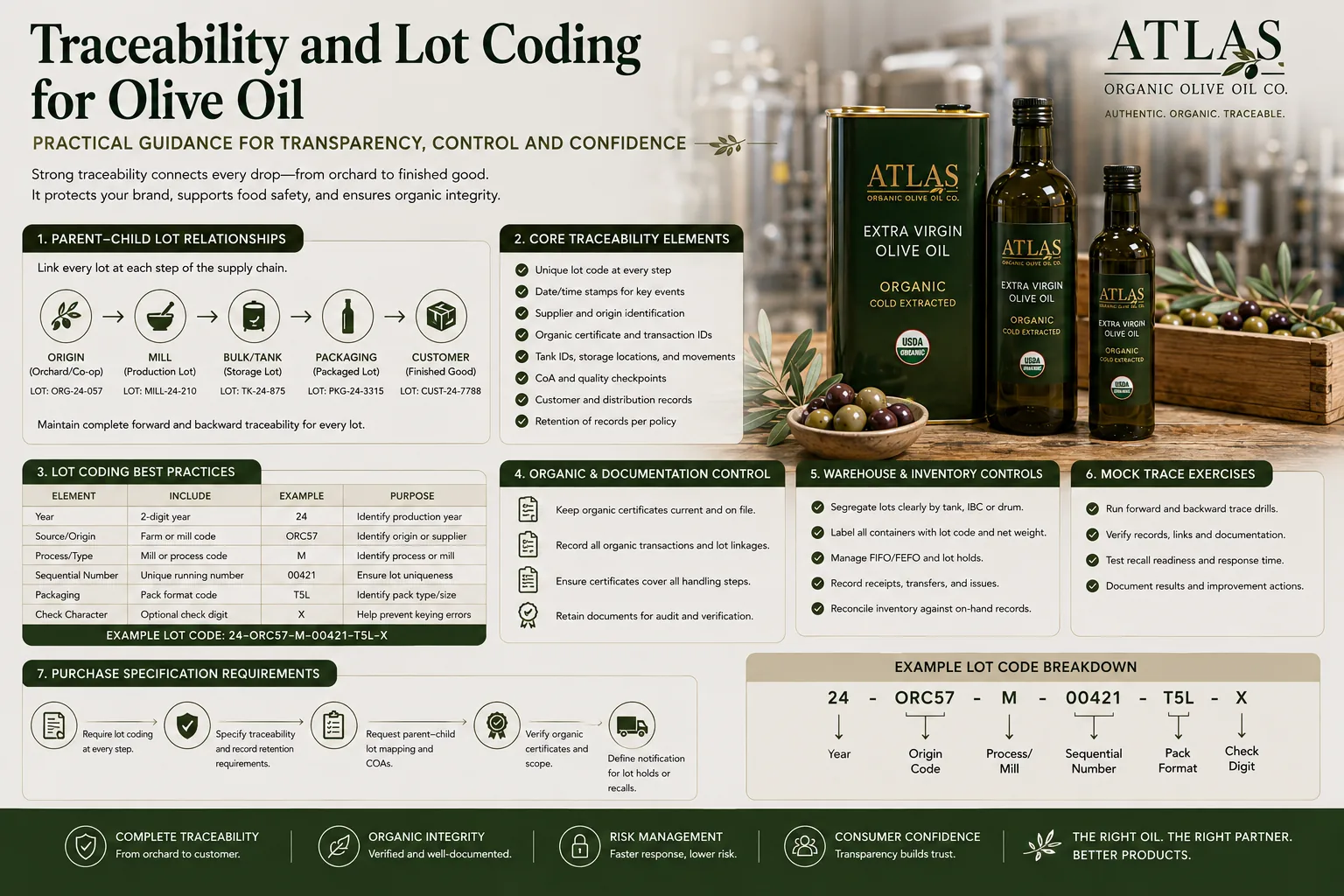
Lot coding should let a quality team move backward to source and forward to customers quickly. The code itself is only one part of the system: its value depends on whether purchasing, quality, warehouse, production and shipping records preserve the same identity consistently.
Traceability must answer two questions quickly: where did this lot come from, and where did it go? Organic programs add another layer of audit-trail documentation because the commercial lot may also need to connect to certification, transaction and handling records. A reliable system therefore links physical product, documents and inventory movements rather than treating the printed lot code as a stand-alone label.
The practical objective is not to create the most complicated coding system possible. It is to create a convention that remains understandable during receiving, storage, transfer, repacking and shipment, while preserving enough information to investigate a complaint, conduct a withdrawal or complete an audit efficiently.
1. Start with the decision framework
Before requesting samples or setting up a new supply program, write down the commercial job the oil must perform. That brief should state the finished product or service application, target market, annual and trial volumes, expected pack format, sensory role, process exposure, storage conditions and required organic documentation.
Traceability requirements should sit inside that same brief. A bulk tanker, intermediate container, private-label bottle and foodservice pack may all need different operational controls, but each should preserve a clear connection back to the supplier lot or lots from which it was produced.
- Define one lot convention that survives receipt, storage, transfer, packing and shipment.
- Make sure supplier lot numbers and internal lot numbers can be reconciled without ambiguity.
- Preserve parent-child relationships whenever one bulk lot becomes multiple packed or finished-goods lots.
- Record which customers, warehouses or distribution points received each released lot.
- Run mock trace exercises that include organic records and any co-packed or repacked product.
A useful specification separates the legal or category baseline from tighter internal targets. It should also state which records are expected with every shipment, which records must be retained, and how long traceability information should remain accessible under the buyer's own quality system.
2. Practical workflow
Move from supplier approval to commercial traceability in controlled steps. First, confirm how the supplier defines a lot. Second, determine how that supplier lot will be represented in your own receiving and inventory system. Third, test whether the identity remains intact through storage, transfer, filling or repacking. Finally, confirm that outbound shipment records can identify every customer or destination that received the resulting product.
- Write a one-page brief. Include category, organic status, harvest or filtration preference if relevant, sensory profile, pack, volume, destination, timing and required traceability records.
- Define lot ownership. Decide which supplier identifier will be captured at receipt and whether an additional internal receiving, production or finished-goods lot number will be created.
- Review documents. Confirm lot identity, analytical results, organic status, traceability and any import, transaction or label records required by the destination market or certification program.
- Pilot the system. Follow a trial lot through receiving, warehouse movement, tank transfer, filling, packing and shipment. Check that each transaction preserves or correctly maps the original lot identity.
- Check parent-child relationships. If a bulk lot is divided into several finished-goods lots, confirm that each child lot can be traced back to its parent and that the parent can be traced forward to every child.
- Run a mock trace. Select a finished lot and trace backward to source documentation, then start with a supplier lot and trace forward to all affected stock and customers.
- Define release and change control. Decide who approves new lot-coding formats, ERP mapping changes, new co-packers, new warehouses or material changes that could interrupt the audit trail.
The best test of a traceability system is speed under realistic conditions. A code may look clear during normal production but still fail if personnel cannot determine which physical inventory, certificates, analytical results and outbound shipments belong to it during an investigation.
3. Quality controls that belong in the conversation
Extra virgin olive oil is defined through more than free acidity. Buyers should use the current applicable category standard, appropriate laboratory methods and—where required—organoleptic assessment. Each certificate of analysis should be tied clearly to the commercial lot being purchased rather than maintained as an undated or generic product document.
Traceability records should also connect the physical oil to the documents used for release. If a supplier shipment contains several lots, the receiving process should capture which quantity belongs to each lot rather than recording only a total shipment quantity.
- Use unique lot IDs consistently across purchasing, quality, warehouse and shipping systems.
- Preserve supplier-to-internal and parent-to-child lot relationships.
- Link current certificates of analysis to the actual shipped lots they represent.
- Keep organic certification and relevant transaction records aligned with product identity.
- Reconcile electronic inventory records with physical warehouse or tank inventory.
- Test the system periodically with documented mock trace exercises.
For storage and distribution, protect oil from direct light, unnecessary heat and repeated oxygen exposure. A premium incoming lot can deteriorate if it is held too warm, transferred turbulently, stored in a partly empty container for too long or packed in a format that does not suit turnover. Traceability records should therefore capture significant transfers or repacking operations that change the product's physical location or lot relationship.
Where several lots share the same tank, intermediate container or packing line, the site should have a documented rule for determining lot boundaries. Without a clear rule, apparently precise lot codes can create false confidence because the physical product may not match the recorded identity.
4. Common failure modes
Most traceability failures do not come from the absence of a printed code. They arise when different departments interpret the code differently or when product movements are recorded outside the system used for quality and shipping decisions.
- Reusing ambiguous date codes that can refer to more than one production or receipt event.
- Losing the relationship between a supplier bulk lot and the bottles, drums or containers packed from it.
- Creating new internal lot numbers without retaining a searchable link to the original supplier lot.
- Maintaining traceability in spreadsheets that are not reconciled to ERP or physical warehouse stock.
- Recording a shipment quantity without identifying which lot or lots were actually dispatched.
- Keeping certificates or organic documents in folders that cannot be searched by commercial lot number.
- Failing to include co-packers, third-party warehouses or repacking operations in mock trace exercises.
Another common weakness appears when codes are technically unique but operationally difficult to interpret. If staff must rely on one employee's memory to understand a code structure, investigation speed can fall sharply when that person is unavailable. The convention and its decoding rules should therefore be documented and accessible to the relevant quality, warehouse and supply-chain teams.
Build corrective-action triggers around objective evidence: out-of-spec results, sensory defects, damaged seals, broken traceability, inventory discrepancies, temperature excursions, packaging failures or documented process deviations. When traceability cannot be demonstrated, the affected stock should be clearly identified and controlled while the discrepancy is investigated.
5. What to put in the purchase specification
The purchase specification should describe not only the oil but also the information needed to maintain its identity through the supply chain. Requirements should be specific enough that both buyer and supplier understand what must accompany each shipment and how commercial lots will be referenced.
6. Reference framework
For category definitions, analytical methods and organoleptic assessment, use the current International Olive Council trade standard and methods together with destination-market rules. Organic traceability should also be reviewed against the certification and transaction requirements that apply to the specific supply chain.
Internal quality procedures should complement those external requirements by defining who records lot information, when lot identity changes, how records are reconciled and how quickly a backward-and-forward trace must be completed during a mock exercise or real investigation.
Next step
Turn this guide into a sourcing brief by listing your application, annual volume, destination, desired format, target launch date, required organic documentation and the quality attributes that matter most. Include any existing lot-coding convention or ERP requirements that the supplier will need to support.
Atlas can then compare suitable organic olive-oil programs on the same commercial basis, including analytical documentation, lot identification, parent-child traceability, packaging configuration and the records required to support repeat shipments.