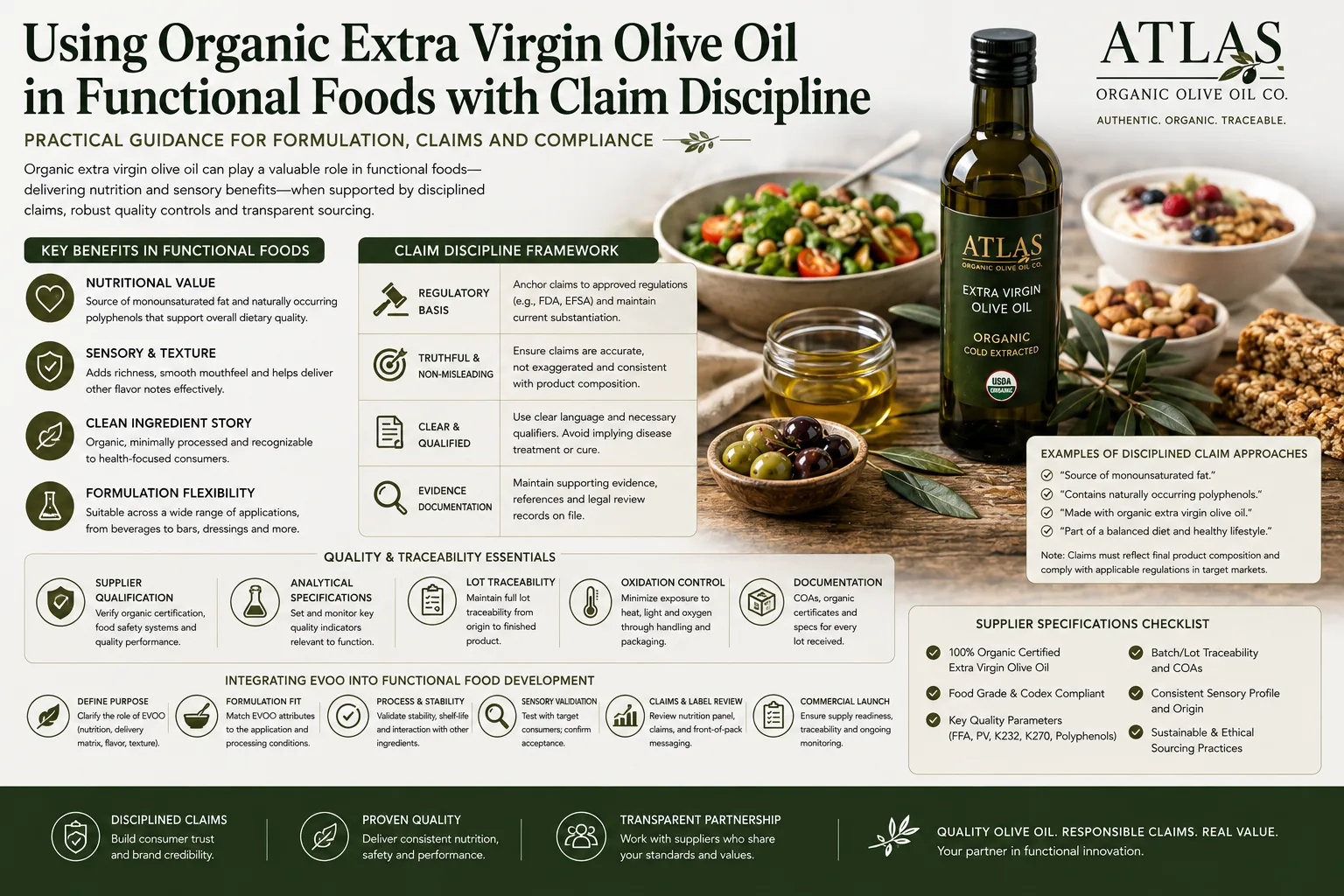
Functional-food positioning creates a high risk of turning compositional facts into unsupported health promises. Organic extra virgin olive oil can be a valuable ingredient, but the commercial value of the oil, the wording used around it and the evidence supporting those statements should be evaluated separately.
Regulatory status is jurisdiction-specific and changes over time. Use current primary rules and competent professional review before printing labels or publishing health-related claims. A statement that is acceptable for an ingredient specification is not automatically acceptable on consumer packaging, advertising or digital product pages. The practical objective is therefore not to find an abstract “best” oil; it is to define the oil, evidence and handling system that remain fit for the intended food, channel and shelf life.
1. Start with the decision framework
Before requesting samples, write down the commercial job the oil must perform. That brief should state the finished product or service application, target market, annual and trial volumes, expected pack format, sensory role, process exposure, storage conditions and required organic documentation. It should also identify whether the oil is primarily being selected for flavor, ingredient positioning, organic status, fat-system performance or a combination of these objectives.
If the oil will be named prominently on the label, the sensory target deserves even more attention. A robust, peppery oil that performs well as a finishing ingredient may be unsuitable for a mild snack, spread or nutritional formulation where other flavors must remain dominant. Conversely, an oil selected only for neutrality may fail to deliver the premium sensory character expected from a product that highlights extra virgin olive oil on the front of pack.
- Separate ingredient quality statements from disease-risk, therapeutic or nutrient-content claims.
- Confirm whether any proposed health or nutrition claim is authorized, permitted or qualified in the target jurisdiction.
- Check whether the finished serving size, formulation and conditions of use satisfy any thresholds attached to the proposed claim.
- Distinguish statements about the oil itself from statements about the finished food containing the oil.
- Maintain substantiation files and ensure marketing language matches the exact evidence available for the finished product.
A useful specification separates the legal or category baseline from tighter internal targets. It also makes clear which values are guaranteed at release, which are typical, and which are only reference data from a particular origin or harvest. This distinction reduces disputes and prevents an attractive historical analysis from being treated as a contractual promise for every future lot.
2. Practical workflow
Move from bench or sample evaluation to commercial approval in controlled steps. First, screen candidate lots against the intended use. Second, test the oil in the real process or handling pattern. Third, confirm that the selected packaging and distribution route protect the oil. Finally, define receiving checks so future lots are judged consistently rather than against a buyer's memory of the original sample.
- Write a one-page brief. Include category, organic status, harvest or filtration preference if relevant, sensory profile, pack, volume, destination, process conditions and timing.
- Sample in context. Taste neat for defects and style, then evaluate in the actual food, process or service condition. Flavor balance can change substantially once the oil is combined with acids, spices, proteins, emulsifiers or sweet components.
- Review documents. Confirm lot identity, analytical results, organic status, traceability and any import, transaction or label records required by the market. Check that names, lot codes and certificate references can be reconciled.
- Pilot the system. Use commercial-equivalent processing, transfer, filling, storage or service conditions rather than relying only on laboratory handling. Include realistic exposure to heat, mixing, headspace and holding time where applicable.
- Validate the finished product. Evaluate sensory stability, package compatibility and relevant quality indicators over the intended life of the product rather than assuming the incoming oil specification alone predicts shelf life.
- Define release and change control. Decide who approves a new harvest, new lot, new pack component, origin change or material specification change, and what evidence is required before approval.
For repeat programs, retain approved samples or sensory references when practical. They give procurement, quality and product-development teams a common point of comparison when a new crop or supplier lot naturally shows some variation.
3. Quality controls that belong in the conversation
Extra virgin olive oil is defined through more than free acidity. Buyers should use the current applicable category standard, appropriate laboratory methods and—where required—organoleptic assessment. Depending on the applicable standard and program, analytical conversations may include parameters related to hydrolytic condition, oxidation, purity and identity. The exact acceptance criteria should be taken from the rules and specifications applicable to the destination market and commercial agreement.
For commercial programs, add internal criteria that describe the sensory style your brand or formulation actually needs. “Extra virgin” identifies a category; it does not define whether the desired profile should be delicate, green, ripe, intensely fruity, bitter or pungent. Sensory alignment is particularly important when the oil forms a noticeable part of the finished product's flavor.
- Identify the exact destination market and applicable olive-oil category standard.
- Separate organic, food-label, category, nutrition and health-claim requirements.
- Define which analytical results must appear on each lot's certificate of analysis.
- Agree how sensory non-conformities, damaged packaging or traceability gaps will be handled.
- Archive the version of rules, certificates and substantiation used for commercial approval.
For storage and distribution, protect oil from direct light, unnecessary heat and repeated oxygen exposure. A premium incoming lot can deteriorate if it is held too warm, transferred turbulently, stored in a partly empty container for too long or packed in a format that does not suit turnover. Bulk users should therefore consider tank size, headspace management, transfer frequency, hose and pump practices and how quickly an opened container is consumed.
Packaging decisions should also reflect the real supply chain. Light protection, closure performance, food-contact suitability, headspace and expected time in distribution may all influence how effectively the oil's original sensory and analytical quality is preserved.
4. Common failure modes
Most problems are not caused by a lack of adjectives on the specification. They come from a missing operational control, an unsupported interpretation of available evidence or from treating one measurement as a complete quality story.
- Using supplier marketing copy as regulatory substantiation for the finished product.
- Implying treatment, cure or prevention of disease without an appropriate legal basis.
- Claiming benefits that depend on a dose or serving level the finished product does not deliver.
- Assuming the word “organic” creates permission for broader nutrition or health claims.
- Approving an oil from a neat tasting without checking its flavor in the finished formulation.
- Using a single historical COA as if it represented every future harvest or production lot.
- Ignoring oxygen, light, heat or package effects after the oil has passed incoming inspection.
Another frequent mistake is allowing regulatory, quality and marketing teams to work from different descriptions of the same ingredient. A supplier may describe a sensory characteristic, a product developer may convert it into a functional benefit and a marketing team may unintentionally turn that benefit into a consumer health promise. A disciplined review process should identify these transitions before the wording reaches artwork or advertising.
Build corrective-action triggers around objective evidence: out-of-spec results, sensory defects, damaged seals, broken traceability, temperature excursions, packaging failures or documented process deviations. Define in advance when a lot should be held, re-tested, investigated or rejected. This makes supplier conversations faster and fairer and creates a clearer audit trail.
5. What to put in the purchase specification
The purchase specification should be detailed enough to control repeat supply without becoming a collection of unnecessary requirements. Every criterion should serve a regulatory, quality, sensory, logistical or commercial purpose, and the method for determining compliance should be understood by both buyer and supplier.
Next step
Turn this guide into a sourcing brief by listing your application, annual and trial volume, destination, desired format, target launch date, processing conditions and the quality attributes that matter most. Add any proposed front-of-pack ingredient wording or functional positioning that may influence the required documentation or product characteristics.
Atlas can then compare suitable organic olive-oil programs on the same commercial basis, aligning candidate oils with sensory expectations, pack format, documentation needs, shipment profile and repeat-supply requirements rather than evaluating price or origin in isolation.